

Since 2002, Corporate Board Member has been conducting an annual survey of U.S. public company board members on all matters of corporate governance, from the top issues on boards’ agenda and the most challenging emerging risks to the evolution of boardroom makeup, shareholder engagement and navigating ever-changing regulatory environments.
In the fall of 2025, Corporate Board Member partnered with Diligent Institute to conduct the 23rd edition of the survey. Over 200 actively serving public company board members responded to the digital survey. This report presents the key findings from the research, along with expert commentary from participating directors and select knowledge partners.
Download the full PDF report or consult the findings below >>

The pursuit of growth through M&A is back at the top of the priorities this year, with nearly half of directors allocating capital to potential deal-making in 2026. Despite growing concerns over the impact of an economic downturn, less than 1 percent of directors view M&A as a top risk.
AI has quickly infiltrated America’s boardrooms to capture the top spot in capital allocation strategies in the year ahead. Boards are seeing emerging capabilities as an opportunity to grasp, as pressure mounts to bring AI to governance oversight.
Directors report greater time investment in scenario planning and expanding scenario scopes to include new or intensifying risks, particularly relating to cyber vulnerabilities and regulatory changes. Meanwhile, 53 percent of directors say they don’t often receive real-time data between meetings, making oversight a challenge.
Directors continue to push for more time dedicated to forward-looking strategic talks, with ‘strategic planning’ topping the issues most pressing to discuss at their next meeting. Meanwhile, as AI continues to consume conversations, boards are increasingly considering bringing in new members with specialized AI expertise.

With Expert Contribution From
Growth is a perennial priority for public companies, and M&A has long been the fastest path to scale. For 2026, the focus is on ‘M&A and strategic partnerships,’ which topped the list of board priorities according to the survey.
And while M&A activity is often driven by regulatory, economic and market conditions, the recent surge in activity has created momentum that some directors believe is driven by a new factor: AI.
This AI-driven M&A thesis is reshaping how boards evaluate targets (see “AI: The Thread Running Through 2026” for the full picture of AI’s impact on board priorities). “If you can bulk up on scale at a reasonable price, then AI potentially gives you the ability to skinny up on efficiency and drive significant alpha,” says Scott Syphax, a director at ProAssurance.
M&A ranks as the second-highest capital allocation priority for 2026 (just behind technology adoption) and sits third on board agendas heading into the new year—trailing AI itself and strategic planning. Shareholders are also adding to the pressure. ‘Long-term strategy’ and ‘M&A opportunities’ top the list of issues discussed with investors this past year, even ahead of short-term performance in what shaped out to be a very dynamic year for business.
Looking ahead, while directors rank ‘a sharp downturn in the U.S. economy’ as the greatest threat to growth, a mere 1 percent cite ‘M&A landscape and corporate valuations’ as a concern, suggesting boards may be betting that economic weakness will create acquisition opportunities, not obstacles.
Which of the following strategies would you identify as top priorities for your company in 2026?
Respondents could select up to three.
In which of the following areas is the company planning to focus its capital investments in 2026?
Directors were asked to select up to two.
This reflects a two-track strategy: companies preparing for organic growth headwinds while positioning for opportunistic M&A. The challenge, however, could be execution: closing deals in a volatile environment while preserving the financial flexibility needed to weather a downturn requires precision timing and disciplined capital allocation.
“We are seeing deal appetite rebounding while the governance, data and integration needed to execute still lag behind according to recent research,” says Kira Ciccarelli, senior manager of research & programs at the Diligent Institute. “That mismatch can turn M&A from a growth engine into a vulnerability if leaders aren’t careful.”
If you were charged with setting the agenda for your next board meeting, which of the following topics would you include as most pressing to discuss?
Respondents could select up to three.
Despite years of headlines about technological disruption, the top concern for business leaders in 2026 is far more traditional: the U.S. economy. A majority of directors cite a ‘sharp downturn in the U.S. economy’ as the biggest risk facing their organizations in 2026. Across the board, macroeconomic concerns and government policies dominate the risk landscape.
It’s easy to see why. Following a year of tariff-driven volatility and constant reforecasting, companies are hoping for a calmer runway to execute strategies that were sidelined in 2025.
But hope alone won’t cut it, and boards are taking action: 58 percent have added economic shocks to their scenario-planning exercises, while 56 percent have incorporated regulatory policy shifts.
In addition, nearly half of board members surveyed report spending more time on scenario planning, and a quarter say they are bringing in internal and external experts more frequently to guide these sessions.
Even more telling: 84 percent have strengthened their scenario-planning approach in some way, underscoring how even the best-laid strategies face heightened disruption risk.
Still, directors say there’s more work to be done. Nearly a third worry most about risks they haven’t even imagined yet, driving the push for more comprehensive planning.
To strengthen risk oversight, 47 percent want more frequent and structured risk discussions at the full-board level—rather than sitting through management presentations—and a third seek clearer connections between risk oversight and strategy setting.
More specifically, which of the following do you consider to be the biggest risks to your organization?
Respondents were asked to select up to three.
Over the past five years, how has your board’s approach to scenario planning changed?
Respondents could select all that apply.
Which of the following types of scenarios are currently incorporated into your board’s crisis preparedness and planning exercises?
Respondents could select all that apply.
Which of the following do you believe would most improve your board’s risk oversight?
Respondents could select up to two.
With Expert Contribution From
Artificial intelligence has become the connective tissue running through virtually every strategic priority, risk concern and governance challenge facing boards in 2026. Yet only 7 percent of directors view technological disruption as a top risk to their business, raising questions about whether boards fully grasp the dual nature of AI as both catalyst and threat.
This gap could reflect genuine confidence that boards are positioned to harness disruption rather than fall victim to it. Or it could signal something more concerning: that directors underestimate how quickly AI-native competitors can upend established business models. The reality is likely somewhere in between, but the lopsided view warrants attention.
The confidence appears rooted in action: 38 percent of directors say deploying AI technology across the business is a top priority this year, the second-highest priority behind M&A. Technology adoption and integration is also drawing significant capital, with 42 percent citing it as a major investment focus for 2026.
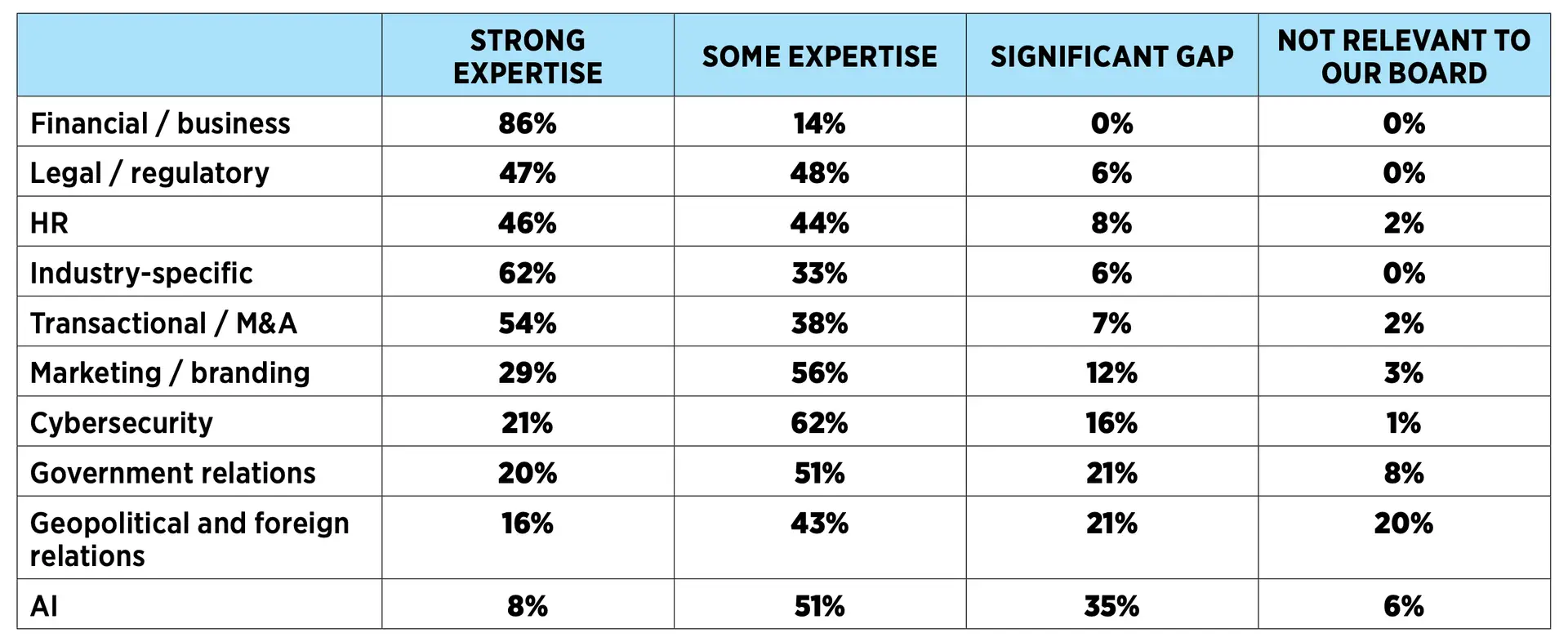
While 44 percent of directors want to elevate AI risks and opportunities to the top of the board agenda, only 8 percent report having strong AI expertise among their ranks—the lowest level of expertise across all areas surveyed—and 40 percent say this issue is among the most challenging for boards to oversee (perhaps for that same reason).
Korn Ferry insights show continued interest from boards wanting to add technology talent around the boardroom table. Many boards are looking for director candidates who have had experience leading through technology transformations, according to the firm’s board & CEO services practice.
“The sense is that these executives have seen the implications not only of AI initiatives and investments, but tech strategies more broadly, as they are playing out in real time—and that perspective can be powerful,” said Tierney Remick, vice chairman and co-head of the practice.
To what extent does your board use AI-powered technology (e.g., dashboards) to support its oversight of risks and strategic decision-making?
Which of the following issues do you find most challenging to oversee in your role as a director today?
Respondents were asked to select up to three.
The board-level AI governance gap extends to boards’ own use of AI.
Recent research conducted by Diligent Institute and Corporate Board Member found that 66 percent of directors use AI for board work, such as meeting preparation. However, only 22 percent report having AI governance processes in place to guide that usage.
Boards that are further ahead in their AI journey report positive results, Kim Van Der Zon, Korn Ferry vice chair, board succession & CEO advisory, says.
“One of my clients is appreciative that AI is greatly facilitating the risk oversight responsibilities of the board because of its ability to deep dive, connect dots, find trends and anomalies. This allows this aspect of fiduciary duty to be a far more robust counterpoint to risk as identified by management.”
Forty percent of directors surveyed say they don’t use AI at all for strategic oversight, and another 33 percent use it only on an ad hoc or limited basis.
This means while boards are betting on their companies seizing tech opportunities to disrupt the marketplace, many are struggling to adopt the very technology they’re asking management to deploy at scale.
According to Korn Ferry experts, this is partly due to the fact that most directors do not have access to their company’s secure enterprise AI so they are very limited in what they can do.
“I was recently in an S&P 500 company boardroom when the corporate secretary explained they had even turned off the AI elements available in the board portal they were using,” said Anthony Goodman, Korn Ferry’s head of board effectiveness.
Compounding the challenge is that leaders of the business are expected to bring robust judgment to decisions, “and historically the board could rely on that,” says Goodman.
Now, there is concern they or their teams may shift to over-reliance of delegation of that judgment to AI. “And when they do, will management even be able to explain why and who made decisions? At what point do boards consider governance must shift from oversight of AI as a technology to fiduciary oversight of decision-making?”
Another challenge is that ‘deploying AI across the business’ comes with significant hurdles, with cybersecurity and data privacy sitting squarely at the center.
As companies integrate more external AI tools and software—often with unvetted processes across the organization—they’re creating new vulnerabilities. AI is simultaneously making cyber-attacks more sophisticated and giving criminals more entry points.
Boards, of course, recognize this: 63 percent have incorporated cyber events into their crisis planning exercises, the highest of all scenarios added in recent years, and 51 percent have added technology-related disruption scenarios.
“We can’t take it for granted that a company, an individual or a website is protected forever,” says Mara Aspinall, a seasoned board member who chaired the OraSure board until stepping down after eight years last November, warning that yesterday’s safeguards may no longer be sufficient.
Still, despite including cybersecurity incidents in their crisis planning at higher rates than any other scenario, and the fact that technological and cyber risk were cited the most frequently as the most underestimated risks of 2026, only 28 percent view cybersecurity as a top organizational risk, and just 12 percent say strengthening cybersecurity and data privacy defenses is a priority for 2026.
The question is no longer whether AI matters, but whether boards can develop the expertise, tools and governance structures to oversee its deployment responsibly while harnessing its competitive potential.
The data suggests many boards are still building that capacity—even as they commit capital and strategic focus to AI transformation.
Directors overall expressed strong confidence in their audit teams’ ability to identify emerging risks, but this optimism may be tested in the year ahead.
Shifting regulations and cross-border trade compliance are forecasted to command more of the boards’ time, alongside financial reporting and audit requirements, organizational culture and employee trust, highlighting the closely intertwined dynamics of the current environment and the criticality of a responsive and alert audit function.
Still, beneath these internal priorities also lie external risks that directors fear are currently underestimated: AI and technology regulation, global privacy and sovereignty rules and supply chain accountability—each a stark reminder that compliance obligations now extend far beyond a company’s walls through third-party relationships and data flows.
As explored in “AI: The Thread Running Through 2026,” half of directors polled say they expect AI and technology regulation to demand the greatest compliance-related board attention in 2026, yet 41 percent believe it’s the most underestimated compliance risk.
Which of the following compliance areas do you expect will demand the greatest board attention in 2026?
Respondents could select up to two.
Which of the following compliance areas do you expect will demand the greatest board attention in 2026?
Respondents could select up to two.
These views mirror the blind spots identified by directors, where technological/cyber risk (46 percent) and AI-related risk (24 percent) are seen as underappreciated across boards in general, a signal that audit and risk committees should treat AI, data and cyber as crosscutting compliance issues rather than siloed risk areas.
“In too many companies the compliance team doesn’t have a seat at the table when it comes to AI governance,” says Kristy Grant-Hart, vice president and head of advisory services for Spark Compliance, a Diligent brand. “Compliance plays a critical role in managing the ethics and legal obligations around AI, so board members need to ensure that they have a role in this key area.”
To support compliance oversight, boards currently rely on management reports and internal audit or risk committee reports, but that may not be enough. Directors say technology-enabled monitoring tools and better integration of compliance into strategy discussions would improve the oversight process.
They also call for enhanced director education and training, as well as increased use of external advisors and experts, suggesting boards need real-time monitoring capabilities and forward-looking analytics, paired with continuous upskilling to keep pace with regulatory change.
These preferences are consistent with the broader risk oversight improvements directors seek: More frequent structured full board risk discussions, clearer linkage between risk and strategy and enhanced use of AI-powered data and technology tools.
“It’s not surprising that boards are seeking expert advice and further training,” says Grant-Hart. “Boards are paying attention to AI, data privacy, sanctions and tariffs, which represent some of the most technical and rapidly evolving regulatory landscapes boards have ever faced.”
Which data source do you find most valuable in helping you with compliance-related matters?
Respondents could select up to two.
Which of the following do you believe would most improve your board’s oversight of compliance?
Respondents could select up to two.

With Expert Contribution From
In the current macroeconomic and geopolitical climate, boards navigate an array of competing priorities, and our survey data indicates human capital discussions may be receiving less dedicated board time in 2026 compared to recent years.
The context, however, is contradicting: Human capital ranked highest among board priorities after themes directly related to financial health and overall business strategy.
One possibility is that human capital considerations have become more deeply embedded across strategic, operational and risk discussions, potentially reducing the need for separate treatment as was common during the 2020 pandemic.
Virtually every S&P 100 company now includes human capital oversight in its Compensation Committee charter, according to WTW’s executive compensation and board advisory practice, a knowledge partner in this year’s research and an expert in human capital matters.
This suggests talent considerations may be becoming more intertwined with aspects of business strategy, from technology deployment to market expansion to operational efficiency.
An alternative explanation may be that human capital considerations are hiding behind the top priorities: Operational expenditures, for instance, often carry substantial people-related implications.
Labor costs typically represent a significant component of most organizations’ operational budgets. Healthcare costs have been increasing at double-digit rates globally for the past three to five years with no clear indication of deceleration.
Still, boards may want to consider this more carefully. If workforce discussions occupy only a small portion of board time and focus narrowly on metrics embedded in other discussions , boards might be missing opportunities for strategic discussion around competitive positioning through talent. They may also be missing important signals that are buried behind broader data.
Then, there’s the AI factor. Directors anticipate AI deployment will require substantial workforce adaptation: 40 percent expect the need for workforce reskilling and training, and 37 percent foresee job redesign and redeployment. Yet fewer than 10 percent report prioritizing overall workforce investment in 2026. Organizations seeking to invest meaningfully in technology will likely need to align investment in talent.
This extends beyond training employees to use new tools. It could involve reimagining work itself, redistributing responsibilities between human judgment and machine capability, and cultivating organizational cultures that embrace continuous learning and adaptation. The data suggests strategic workforce planning may need to play a more central role in AI implementation planning.
Expert Advice From
Boards should press management teams on whether their talent acquisition strategies have evolved to capitalize on these market shifts. Questions to consider:
Are we still applying outdated criteria around tenure and career progression that may cause us to overlook high-potential candidates?
Have we adjusted compensation and career development frameworks to appeal to professionals who prioritize learning and growth over long-term stability?
Do our recruiting processes effectively assess candidates’ adaptability and learning agility— qualities that matter more than ever in rapidly changing environments?
With Expert Contribution From
After two years of unusually high C-Suite turnover, ‘succession planning at the CEO and senior executive level’ has shifted from second place to fifth on the list of issues directors find most difficult to oversee. Yet 51 percent of directors expect ‘executive turnover and succession planning’ to command the greatest attention in 2026.
This apparent contradiction may reveal something interesting: Boards could be gaining experience and developing more robust processes for succession planning, potentially reducing the perceived difficulty level, while simultaneously recognizing it as a persistent strategic priority that requires ongoing attention.
The proportion of directors marking CEO and senior executive succession planning as a board priority has followed a notable trajectory—from 20 percent in 2018 rising to 37 percent post-pandemic, and back to 20 percent in 2026.
This return to 2018 levels invites multiple interpretations. One possibility is that it reflects normalization after a period of acute disruption and heightened uncertainty. Boards that built succession processes during the turbulent years of 2020-2024 may now feel more confident in their preparedness.
On the Agenda: Proportion of Directors Marking ‘CEO & Senior Executive Succession Planning’ as a Priority
Which of the following human capital topics do you expect will demand the greatest board attention in 2026?
Respondents could select up to two.
The data shows executive succession (51 percent) and skills development for emerging technologies (45 percent) leading the list of human capital priorities, suggesting boards continue to focus on leadership continuity.
Additionally, only 3 percent of directors indicate their board doesn’t oversee human capital matters, suggesting human capital governance has become nearly universal in board practice.
Meanwhile, compensation structures appear relatively stable. The majority—though slim—report having made no change to their executive compensation plans in recent years.
Among those who implemented changes, the most common was the introduction of retention-focused awards or bonuses. This pattern could suggest either that compensation committees view current structures as appropriate, or that the complexity of those structures makes changes challenging due to concerns about unintended consequences of modifications.
Compensation committees often maintain that fundamental performance principles should remain constant: organizations set budgets, and executives are rewarded for achieving them. The substantial value in long-term incentives means that even if an executive misses annual targets but outperforms peers and drives stock appreciation over multiple years, they would typically be well compensated.
However, this compensation philosophy may face pressure from several converging factors:
In response to shorter executive tenures, has your board made any of the following changes to executive compensation design?
Respondents could select all that apply.
Every year for the past 20+ years as part of the What Directors Think survey, Corporate Board Member has asked directors about the attributes and skillsets that are top of mind when searching for their next board appointee. And every year, the answers topping the list have been the same: C-Suite experience, financial expertise, industry knowledge—with variances on how each rank amongst themselves.
Then came AI.
In 2025, ‘technology background’ overtook financial expertise to take the third position on the list—a first in our survey’s history. And in 2026, ‘AI expertise’ came in fourth place, with the usual three back in their traditional spots and ‘technology background’ returning to a lower rank on the list.
Considering only 8 percent of directors say their board has strong AI expertise—the area with the least expertise on boards—and that AI is consuming strategy discussions, it may not come as a surprise, but the idea of onboarding a specialized director, rather than one with broad business knowledge, has always been controversial. There are concerns among directors that specialists may not be able to add the value without also possessing industry experience or general business acumen.
Looking at your current board composition, which of the following attributes would you like to see your next director appointment bring to the table?
Respondents were asked to select up to three.
Which mechanisms does your board use to evaluate director performance?
Respondents were asked to select all that apply.
The challenge then is how boards are expecting to find someone with AI expertise in addition to C-Suite experience. Plus, as some directors pointed out, what constitutes AI expertise today? Some directors believe the best course of action at this stage may be to think outside the traditional board demographics of former CEO or CFO and seek individuals with varied leadership backgrounds, such as CISO, CHRO or COO—individuals who have the senior leadership experience but also the ability to be a subject matter expert for the board.
But boards can’t stay relevant without regular evaluations. Yet most aren’t conducting them rigorously. Three- quarters of directors say their boards conduct self-assessments to evaluate director performance. But only 30 percent include an external facilitator and 38 percent use peer reviews—two of the most critical elements of unbiased evaluation. Just 8 percent believe overhauling board evaluations would help optimize oversight.
How would you assess your board’s level of expertise in the following areas?
Nearly half of directors polled say they now receive real-time or near-real-time operational data between meetings, allowing them to monitor performance as it unfolds rather than reviewing it months later. The change reflects the velocity of today’s business environment, where quarterly snapshots can miss emerging risks or opportunities.
Yet access to live data hasn’t solved a persistent frustration: 56 percent of directors wish board meetings focused more on forward-looking discussions, according to the Director Confidence Index, a quarterly poll conducted by Corporate Board Member and the Diligent Institute.
The puzzle? Seventy-eight percent say their meetings already balance retrospective reporting with planning and forecasting—suggesting real-time data is being used to monitor the present, not reimagine the future.
Digital infrastructure is quietly becoming the backbone of this evolution. Nearly seven in ten directors say their boards use digital tools—board portals, secure messaging, AI-assisted briefings—”regularly” or “extensively” to support governance, while roughly a third use them only “occasionally” or “not at all.”
How often does your board receive real-time or near-real-time operational performance data between meetings?
How much of your board meeting time is typically spent on retrospective reporting vs. planning and forecasting?
The plumbing is there in many boardrooms. The next step is using those tools not just to digitize board books to change the quality and cadence of oversight.
Only a small proportion of directors say AI is fully embedded in their oversight processes, while most either don’t use it at all or tap it only on a limited, ad hoc basis.
Forty percent say having access to AI-powered technology for board work would help improve oversight.
Those findings are a stark contrast to the broader survey theme, where deploying AI across the business and elevating AI on the board agenda are top strategic themes. In other words, organizations are moving quickly to deploy AI, while using AI in governance lags.
“Looking ahead, high performing boards will treat governance as a continuous discipline, built on real time data flows rather than periodic reports,” says Dottie Schindlinger, Diligent Institute’s executive director. “And they will increasingly rely on integrated digital platforms—and, over time, AI driven analytics—to surface patterns, flag emerging risks and point directors to where their judgment is needed most, while keeping human decision making firmly at the center.”
If you were asked to optimize your governance oversight process, which of the following actions would you recommend for your board?
Respondents were asked to select all that apply.
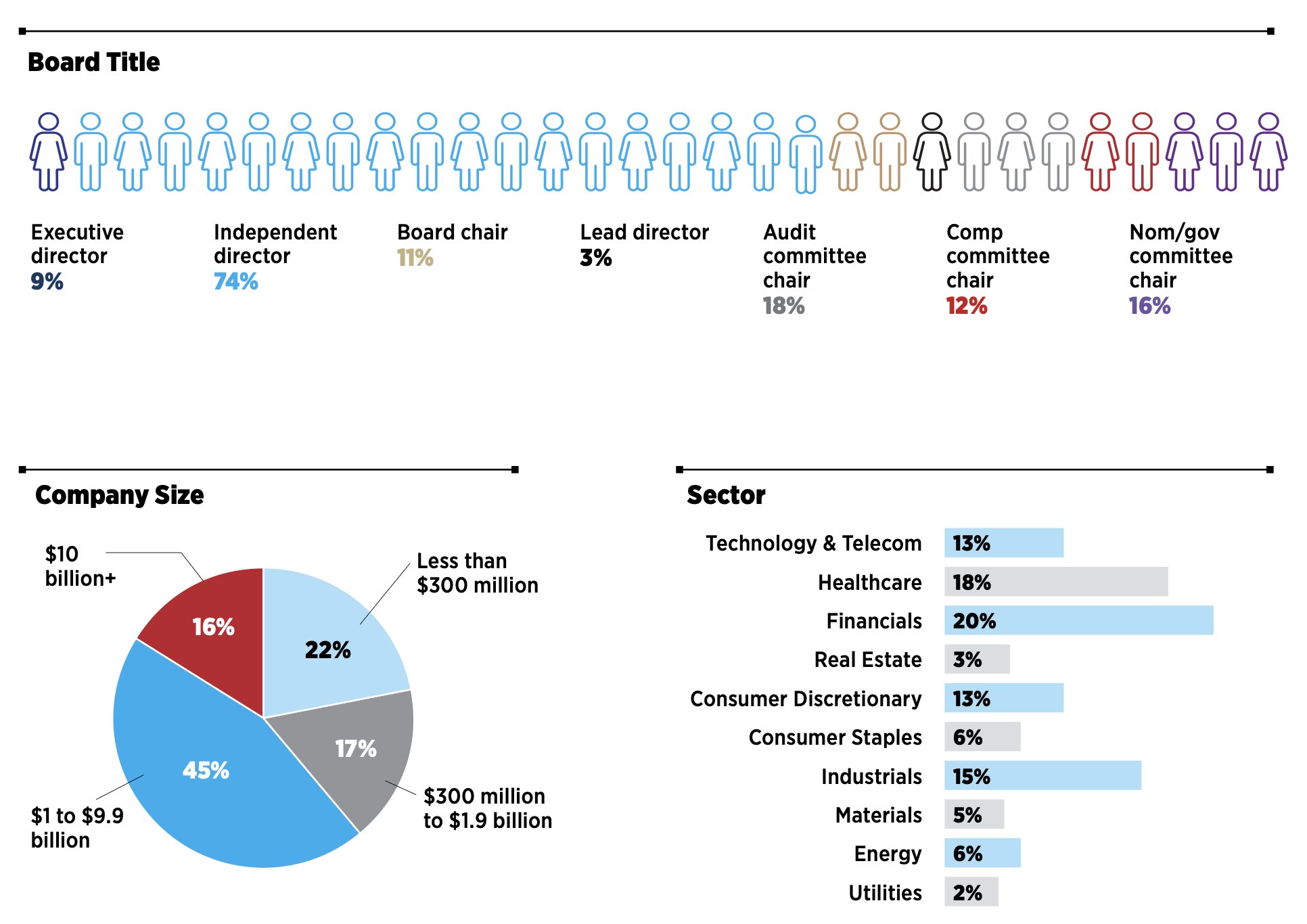
Since 2002, Corporate Board Member has been surveying public company board members in the U.S. on their governance practices. What Directors Think is our flagship research, which gathers insights from more than 200 directors each year on their priorities, challenges, outlook and impressions of America’s business climate, including what’s changing inside boardrooms around the country. Below are the demographics of the directors who participated in this year’s survey.
Corporate Board Member, a division of Chief Executive Group, has been the market leader in board education for 20 years. The quarterly publication provides public company board members, CEOs, general counsel and corporate secretaries decision-making tools to address the wide range of corporate governance, risk oversight and shareholder engagement issues facing their boards. Corporate Board Member further extends its thought leadership through online resources, webinars, timely research, conferences and peer-driven roundtables. The company maintains the most comprehensive database of directors and officers of publicly traded companies listed with NYSE, NYSE Amex and Nasdaq. Learn more at BoardMember.com.
Diligent Institute provides thought leadership, content and programming to inform, educate and connect corporate leaders in meaningful ways. We provide original research based on survey data, quantitative data and disclosures, and interviews with subject matter experts and corporate leaders; informational and educational content in the form of podcasts, webinars, blogs, newsletters and more; and virtual and in-person events and programming for board members and the C-suite.
Learn more at diligentinstitute.com.