

Consistently ranked as one of the most valuable parts of the Directors Forum, these private, role-based discussions are unstructured by design. With no formal presentations and no press in the room, directors engage in candid, off-the-record dialogue with peers who understand their challenges firsthand.
Participants help shape the agenda in real time, ensuring the conversation focuses on what matters most right now. Select the group that best reflects your board role:
It’s hard to imagine a more challenging — or more successful — transformation than the one Greg Brown has led at Motorola Solutions. From a headline-stealing battle turned partnership with activist Carl Icahn, to the splitting of a company that once topped $40 billion in revenue, to a run of 60 acquisitions and a pitch-perfect refocusing strategy that’s delivered more than 1,400 percent in total shareholder return since the split, Brown — Chief Executive’s 2026 CEO of the Year — is the architect of one of the great corporate turnarounds of the era. In an exclusive one-on-one, he sits down with editor in chief Dan Bigman to share what he’s learned about governance, about strategy, and about how boards can and must reshape their organizations to prosper in a fast-changing world.

CEO, Motorola Solutions
M&A has consistently ranked among directors’ top priorities in Corporate Board Member’s What Directors Think study. It has also become one of the leading catalysts for activist campaigns. The strongest boards don’t wait until a deal appears to begin asking hard questions. They establish a clear acquisition framework well in advance, regularly assessing where M&A could accelerate strategy, where it could destroy value, and how they would respond if their own company became a target.
The session will begin with a discussion of leading practices for integrating M&A into the board’s ongoing strategic planning process. Directors will then move into an interactive exercise, assuming the roles of a strategic buyer, target company, or dissenting board voice to evaluate a realistic transaction from competing perspectives before presenting their recommendations.
The objective isn’t to determine whether the deal gets done. It’s to strengthen the judgment, discipline, and oversight that distinguish boards making deliberate strategic decisions from those reacting under pressure.

Leader, U.S. Center for Corporate Governance, BDO

Principal and Leader, Customs & International Trade Services, BDO

Political Economist & Associate Professor, Arizona State University

Principal and Leader, Customs & International Trade Services, BDO

CEO succession is one of the board’s most consequential responsibilities. It’s not just about selecting the next leader—it’s about ensuring the organization has the leadership it needs for the future while maintaining the confidence of the current CEO. With CEO tenures shortening and the demands of the role evolving, succession planning must become an ongoing strategic discussion, not an event.
In this interactive session, directors will work through a realistic succession scenario that looks beyond the immediate transition to define the leadership their company will need over the next five to 10 years. Working in small groups, participants will weigh internal versus external candidates, discuss how to develop future leaders while maintaining a strong relationship with the sitting CEO, and identify what the board should be doing now—not when the seat is already empty.

Co-Chair, Shareholder Activism & Corporate Defense Practice, Sidley Austin

Global Head of Shareholder Engagement and M&A Capital Markets, JP Morgan
In fencing, en garde is the command to get into position before the bout begins. Like a champion fencer, boards that are truly en garde are alert, positioned and prepared before a threat materializes rather than reacting after the fact.
USA Fencing’s story isn’t just about the sport. It’s about what it takes to rebuild an organization from the ground up, govern a passionate and demanding stakeholder base, and lead with mission when financial leverage is limited. In this fireside conversation, USA Fencing’s president will share what running a national governing body actually looks like: where the board leads and where it stays out of the way, how you build accountability without compensation as the lever, how you handle duty of care obligations when things go wrong, and how you keep a long-term mission intact when short-term pressures are real.

Principal, PwC’s Governance Insights Center

Director, PwC’s Governance Insights Center

Join us for cocktails and an evening with USA Fencing as world-class competitive fencers demonstrate the speed, precision and strategy of the sport up close. Then it’s your turn: suit up, pick up a foil, and find out firsthand what it feels like to be en garde. No experience necessary — just a willingness to step onto the strip!
Optional small-group conversations to dive deeper into specific governance and committee-focused topics with your peers and subject matter experts. Topics may include Technology Committees, Shareholder Activism, Cybersecurity.
Pricing is one of the most powerful—and least scrutinized—drivers of enterprise value. In this focused breakfast roundtable, directors will examine pricing not as an operational tactic but as a governance issue: How do you evaluate true pricing power versus optimistic assumptions? What signals indicate “quiet erosion” before it shows up in earnings? And what does effective pricing oversight look like in terms of cadence, accountability and guardrails? You’ll leave with sharper questions to bring back to your boardroom—and a clearer lens on pricing as a strategic lever for sustainable growth.

Partner and Board Member, Simon Kutcher

In today’s environment, credibility isn’t assumed—it’s earned, shaped, and amplified. For directors looking to deepen their influence or secure additional board roles, a clearly defined personal brand can serve as a strategic asset. This roundtable will explore how board members can elevate their visibility as subject-matter authorities, communicate their leadership philosophy with clarity, and cultivate trust with stakeholders—from investors to nomination committees. We’ll explore actionable ways to strengthen your professional narrative, build thought leadership in a cluttered space, and ensure your voice stands out as board opportunities evolve.

Publisher, Forbes Books
The dissolving line between physical security and cyber security exposes executives and their families to unprecedented risks, with attacks ranging from doxxing to ransomware and physical harassment. Organizations must bridge gaps between IT and physical security to address this expanding attack surface.
Join this session to discuss:
– Conducting holistic threat assessments across personal and professional domains
– Unifying IT and physical security teams for coordinated protection
– Closing organizational gaps to reduce risk and safeguard executive well-being

Chief Experience Officer, BlackCloak
Most boards can articulate what makes their company successful today. Fewer have rigorously challenged whether that advantage will still hold tomorrow. As markets evolve and new competitors emerge from unexpected places, yesterday’s strengths can become tomorrow’s vulnerabilities.
In this interactive session, directors will examine what truly creates durable competitive advantage—and how quickly those advantages can erode as technology, regulation, customer expectations, and adjacent competitors reshape industries. Working in small groups, participants will identify the “moat” protecting their own companies, challenge one another’s assumptions, and evaluate how resilient those advantages would be if the competitive landscape suddenly changed.
You’ll leave with a practical framework—and a better set of questions—to help your board pressure-test the durability of your company’s competitive advantage before someone else does.

Office Managing Shareholder Co-Chair, Privacy and Data Security Practice Group, Littler

Board Member, SEALSQ; MIT Media Lab Fellow (Cybersecurity)

As we move into 2027, AI oversight is no longer just about approving investments or understanding the technology. As AI becomes embedded across the enterprise, boards must be prepared to oversee difficult decisions involving accountability, liability, disclosure, cybersecurity, workforce disruption, and reputational risk—often with incomplete information and evolving facts.
Working in small groups, participants will tackle realistic boardroom scenarios drawn from issues companies are beginning to face today. Whether an AI-enabled product causes harm, an autonomous system makes an unintended decision, or an AI initiative fails to deliver on its promises, directors will grapple with questions such as: What should the board have asked before this happened? Who is accountable? What should be disclosed? And where does oversight end and management responsibility begin?
The objective isn’t to become AI experts. It’s to build the judgment boards need when AI creates consequences—not just opportunities.

Managing Director, Pearl Meyer

Board Member, Azenta Life Sciences, Psychemedics Corp. and Akston Biosciences Corp.

Only 35% of executives rate their boards as excellent or good. The gap between a board that checks the boxes and one that genuinely adds value isn’t usually about skills or intentions. The boards that pull ahead share a different set of habits: they ask harder questions, tolerate more productive tension, and hold themselves to the same standard of accountability they expect from management.
In this interactive session, you’ll assess your own board across a handful of specific dimensions, such as quality of debate, the board-management boundary, use of meeting time, and director evaluation, and identify the one change that would most move the needle. A facilitated discussion will draw out common patterns and close with concrete practices from boards that have made the shift from good to great.

Head of M&A and Activism, Americas, FTI Consulting

Partner & Co-Head of Shareholder Activism Practice, Sullivan & Cromwell

“The greatest barrier to execution isn’t the quality of your strategy. It’s whether your organization can receive it, believe it, and act on it.”
Every organization has a strategy. What separates those that execute from those that stall is whether that strategy successfully reaches the people responsible for delivering it.
A former senior executive at Walt Disney Studios and President of National Geographic Films, Adam has led projects that generated billions in global revenue, including Dead Poets Society and March of the Penguins. His new book, Fearless Persistence, makes an argument that cuts to the heart of what boards oversee: every company has a strategy, every company has data, and yet some ideas catch fire while others burn out, despite every rational advantage. Today, as Professional Faculty at UC Berkeley’s Haas School of Business, he advises boards and senior executives from Fortune 100 companies, Silicon Valley’s leading technology firms, high-growth startups, and sovereign wealth funds on strategy, communication, change management, and organizational alignment.
His work is built around one principle: Quality × Acceptance = Effectiveness. Even the best strategy fails if people don’t understand it, believe it, or act on it.
In this closing conversation, Adam will share how leaders can diagnose why strategy loses momentum, why transformation initiatives struggle to gain traction, and how to build communication systems that align organizations, accelerate execution, and produce lasting results across the market and into the future.

Former President, National Geographic Films; Former senior executive, Walt Disney Studios
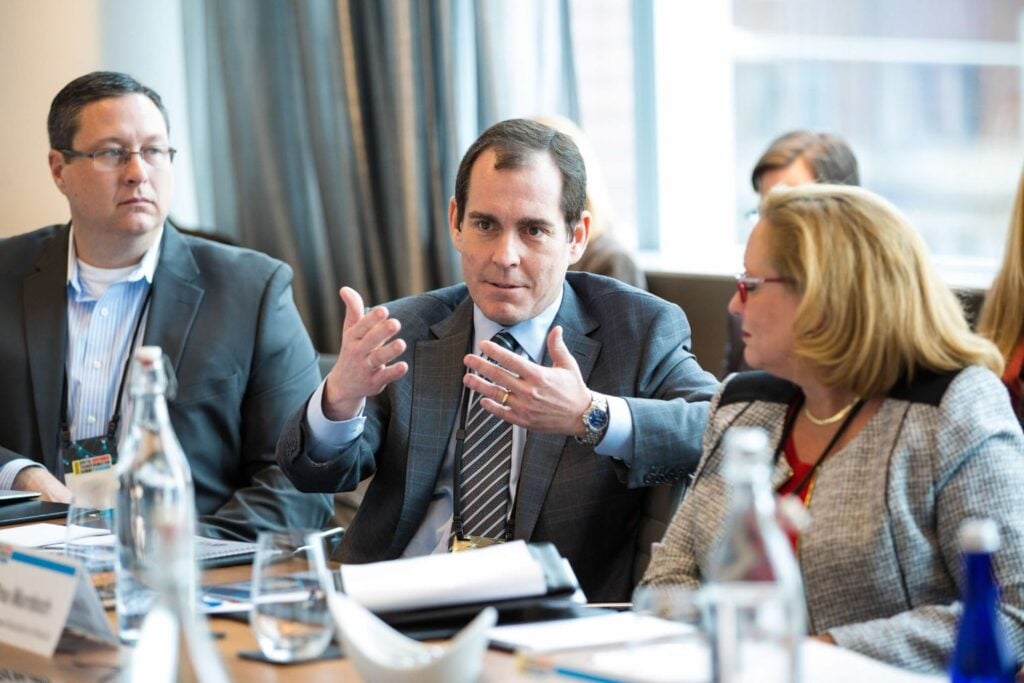
Come ready to share challenges, compare oversight strategies and trade lessons with peers navigating similar pressures.
Audit Committee Exchange
From evolving disclosure requirements to AI risk oversight, the audit committee’s scope continues to expand—while expectations around accuracy, ethics, and internal controls have never been higher. This off-the-record session gives audit chairs and members a chance to compare approaches to managing external auditor relationships, cybersecurity readiness, audit committee workloads, internal reporting, and emerging financial risk.
Compensation Committee Exchange
Today’s comp committees are under increasing scrutiny—not only for pay-for-performance alignment, but also for how executive incentives reflect evolving priorities around risk, culture, human capital, and long-term value creation. In this session, compensation committee members and chairs will exchange views on evolving incentive structures, performance metrics, DEI-related targets, shareholder engagement, and how comp intersects with succession planning and CEO evaluation.
Nominating & Governance Committee Exchange
With heightened focus on board composition, refreshment, committee mandates, and ESG-related responsibilities, the nominating & governance committee plays a critical role in shaping long-term board effectiveness. This session offers committee members a private forum to discuss recruitment strategies, onboarding and director education, committee evaluation practices, shareholder expectations, and how to evolve governance practices to stay ahead of risk and disruption.
Chairmen & CEOs Exchange
Whether you’re a non-executive chair, lead director, or sitting CEO, this conversation is for the most senior voices in the boardroom. You’ll engage in a candid peer dialogue around topics like managing the board/management boundary, building trust across leadership transitions, ensuring alignment on strategy and risk, and leading through external pressure—whether from activists, regulators, or the media.
General Counsel Exchange
The GC’s role as board advisor and governance steward has never been more critical—or more complex. In this session, public company GCs will gather to discuss boardroom dynamics, director engagement, disclosure challenges, regulatory developments, and how legal teams are helping boards navigate emerging areas of risk like AI, cyber, and ESG litigation. A private, practical forum to sharpen judgment and compare strategies with those who walk the same tightrope.
Board-Ready Executives Exchange
For executives actively pursuing a public company board seat, this interactive workshop goes beyond resume writing to help you understand what boards are really looking for—and how to position yourself accordingly. You’ll gain candid insights from sitting directors and boardroom decision-makers, explore how to apply a director’s mindset to governance challenges, and refine your board value proposition and bio with peer feedback. Leave with greater clarity, confidence, and a sharper strategy for landing the right board opportunity.