
Agenda

Tuesday, September 29

9:00 – 9:30 am

Registration and Networking

9:30 – 9:45 am

Welcome and Board Committee Peer Exchange Kick-off

9:45 am – 12:30 pm

Concurrent Peer Exchanges

Role-Based, Off-the-Record Conversations with Your Peers 

Corporate Board Member’s Board Committee Peer Exchange is consistently rated the most valued part of the Summit because it’s where the real conversations happen. No slides. No scripts. No press. Just you and your fellow public company directors tackling the issues you decide matter most. 

Each group is intentionally small and curated by board role and company size to ensure the conversation is both relevant and inclusive. Facilitators help guide the flow, but the agenda comes from you. 

The result: candid, practical, peer-tested insights you can take straight back to your board—shared in an environment designed for real problem-solving. 

Peer Exchange groups include:  

  • Audit Committee  
  • Compensation Committee  
  • Nominating/Governance Committee  
  • Lead Directors & Board Chairs  
  • General Counsel
 

Ahead of the Summit, we’ll gather your input to shape each committee’s discussion topics—so every session reflects what you are navigating right now. 

12:30 – 1:15 pm

Networking Break

1:15 - 1:25 pm

Boardroom Summit Welcome

1:25 – 1:55 pm

Looking Inside: How An Activist Sees Your Company

Activism today is faster, more data-driven, and more strategic than ever. Activist investors are scrutinizing capital allocation, board composition, succession planning, and strategic clarity long before a proxy contest becomes public. Some boards are earning trust and credibility. Others are signaling vulnerability without realizing it.

In this candid fireside conversation, a leading activist will walk through how they evaluate companies and boards: what signals suggest strength, what signals suggest vulnerability, and how a thesis takes shape. We’ll explore where boards most often misread investor sentiment, how quickly patience can erode, and what separates companies that withstand pressure from those that invite it.

Pat Tucker

Head of M&A and Activism Communications, Americas, FTI Consulting

Nicholas Donofrio

Board Member, HYPR, Quantexa and SecurityScorecard; Former Board Member, AMD and NACD; Retired EVP of Innovation and Technology, IBM

Kathy Hannan

Board Member, Annaly Capital Management, Otis Worldwide Corporation and Ginkgo Bioworks Holdings

Loretta Keane

Board Member, Eversource Energy

1:55 – 2:10 pm

Table Discussions: What Would Your Investors Say About You?

After hearing the activist’s perspective, take 15 minutes with your table to pressure-test your own board’s blind spots. If an activist showed up tomorrow, what would be their first critique of your company’s oversight of strategy, risk, AI, or capital deployment? And, what one question should your board add to its next agenda to strengthen oversight in that area?

Len Elmore

Board Member, 1800Flowers.com and Byrna Technologies
Steven Mizell

Board Member, Allegion, Group 1 Automotive and Grail Inc.; Former CHRO, Merck & Co.

Matt Paese

EVP – Board and C-Suite Services, APTMetrics

Steven Mizell

Board Member, Allegion, Group 1 Automotive and Grail Inc.; Former CHRO, Merck & Co.

2:10 - 2:40 pm

Looking Outside: The 2026 Geopolitical Playbook for Boards

For companies across the globe, geopolitics has moved from a peripheral consideration to a key driver of the operating environment. Great power competition, regional conflicts, sanctions, and evolving industrial policies are reshaping markets and influencing decisions regarding investments, supply chains, and operational resilience. What was once seen as an external risk is now deeply intertwined with corporate strategy and long-term growth.

In this fireside conversation, Ambassador Marc Grossman will share his perspective on the global dynamics shaping board agendas in 2026 and beyond. Drawing on his experience at the intersection of diplomacy and business, he will explore how companies are redefining their approaches to growth, risk, and resilience. He will also highlight the critical questions leaders should be asking to help their organizations adapt and thrive in an increasingly uncertain world.

Ambassador Marc Grossman

Vice Chairman, The Cohen Group

Oksana Koltko Rosaluk

Partner, DLA Piper LLP

Matt Paese

EVP – Board and C-Suite Services, APTMetrics

Steven Mizell

Board Member, Allegion, Group 1 Automotive and Grail Inc.; Former CHRO, Merck & Co.

2:40 – 2:55 pm

Table Discussions – Design Your 2026 Geopolitical Dashboard

With fellow directors at your table, you’ll break down key takeaways to identify the 5 leading indicators your boards should be tracking to prioritize your geopolitical risks in the coming year. What are the must-have geopolitical KPIs your board should monitor, and how is this information going to come to the board?

2:55 – 3:15 pm

Networking Break

When Risk Moves Faster Than Strategy: How Board Oversight Must Evolve


Boards are navigating a risk environment that is increasingly nonlinear, interconnected, and fast-moving. Yet many oversight models remain anchored in static dashboards, periodic reviews, and assumptions that may no longer hold. In this interactive session, directors will examine how risk oversight must evolve as strategy and disruption collide more frequently. Drawing on new research from Corporate Board Member and the EY Center for Board Matters, we’ll explore where boards stand today—and where oversight practices may need to shift.

Through interactive, engaging exercises and table discussion, participants will put together their own action plan by exploring questions such as:

  • How does our risk management enable enterprise resiliency?
  • How should we define risk thresholds appropriately to trigger strategic reassessment?
  • Are directors challenging the assumptions behind strategy—or simply monitoring indicators.

This session is designed to spark candid peer dialogue and practical reflection—so you leave with at least one action item you plan to bring back to your own boardroom.

Claire Bennet

Board Member, AutoNation

Mark Besca

Board Member, Markel Group, Las Vegas Sands and Clarus Corporation

Cigdem Oktem

Leader, EY America’s Center for Board Matters

3:15 – 4:00 pm

4:00 – 4:15 pm

Networking Break

4:15 – 4:30 pm

8th Annual Board Leadership Awards

Sponsored by


The Board Leadership Awards celebrate the directors and boards who aren’t just meeting governance expectations—they’re resetting them. Past and present honorees embody the discipline, foresight, and conviction required to guide companies through uncertainty while creating value for shareholders, employees, customers, and communities.

At a moment when strong board leadership matters more than ever, we’re proud to spotlight this year’s Independent Director of the Year honoree:

John Brock

Lead Director, Royal Caribbean Group

4:30 – 5:15 pm

How Great Boards Lead When It Matters Most

Panel with award honorees 

We’ll sit down with this year’s Director of the Year honoree, John Brock to reflect on what it actually takes to provide effective oversight when the stakes are highest — how to support bold strategic decisions without rubber-stamping them, how to manage the board-management boundary through leadership transitions, and what he’s learned from decades leading complex, consumer-facing businesses about the judgment calls that define a board’s legacy.

John Brock

Lead Director, Royal Caribbean Group

5:15 – 6:30 pm

Board Leadership Awards Celebration & Networking Reception

Sponsored by

Join fellow attendees for some festive networking as we celebrate our award honorees together in-person!

Dan Bigman

Editor-in-Chief & Chief Content Officer, Chief Executive Group

David Garfield

Global Co-CEO and Board Member, AlixPartners

Wednesday, September 30

7:00 – 8:30 am

Breakfast

7:30 – 8:15 am

Breakfast Ask-the-Expert Roundtables

Gather with director peers and subject matter experts to explore pertinent board issues in a small group setting to allow for ample Q&A and idea sharing. Topics to be announced.

Attracting and retaining key executive talent is a priority for most Compensation Committees. In an increasingly competitive market where pay levels continue to increase, one-time special awards are more prevalent and leadership stability is paramount, it is more important than ever to examine compensation programs for their performance leverage and retentive qualities. This is even more pronounced in roles that oversee and manage Artificial Intelligence (AI) strategy. At this morning’s roundtable we will discuss some of the issues facing Compensation Committee members and approaches for addressing these challenges.

Kelly Malafis

Founding Partner, Compensation Advisory Partners

In today’s environment, credibility isn’t assumed—it’s earned, shaped, and amplified. For directors looking to deepen their influence or secure additional board roles, a clearly defined personal brand can serve as a strategic asset. This roundtable will explore how board members can elevate their visibility as subject-matter authorities, communicate their leadership philosophy with clarity, and cultivate trust with stakeholders—from investors to nomination committees. We’ll explore actionable ways to strengthen your professional narrative, build thought leadership in a cluttered space, and ensure your voice stands out as board opportunities evolve.

Michelle Prince

Publisher, The Leading Authority

This year’s proxy disclosures were a reflection of 2024 compensation actions—and the world has changed a lot since those decisions were made. This discussion will focus on emerging compensation trends in response to tariffs, ESG pushback, an increased focus on executive security, designing incentives to address macroeconomic volatility, and more.

Eric Henken

Managing Director, FW Cook

8:30 – 8:35 am

Welcome

8:35 – 9:10 am

When AI Starts Making Decisions: Board Oversight in the Era of Autonomous Operations

AI is no longer just generating insights — it is making decisions. Across industries, algorithms are allocating capital, adjusting pricing, approving transactions, managing supply chains, and triggering operational shifts at machine speed. Autonomy is quietly moving from pilot projects to enterprise infrastructure. For boards, this is not a technology story. It is a paradigm shift in oversight.

When decisions are distributed across models rather than concentrated in executives, what changes about accountability? How should directors think about risk appetite when systems can act before humans intervene? Where do guardrails belong — and who owns them?

This opening session will challenge directors to rethink oversight for a world where AI doesn’t just inform management judgment — it increasingly becomes part of it. The question isn’t whether autonomy is coming. It’s whether boards are prepared for what it means.

Philipe Salle

Chairman and CEO, Atos Group

Florin Rotar

Chief Technology Officer, Atos

Linda Riefler

Board Member, MSCI and CSX

Carin Robinson

Director, PwC Governance Insights Center

9:10 – 9:50 am

AI + Cyber: The New Architecture of Enterprise Risk

AI is accelerating the cyber threat landscape in ways few governance models were designed to handle. From AI-assisted social engineering and autonomous attack chains to compromised training data and emerging quantum implications for encryption, the foundations of digital trust are shifting. The pace and complexity of threats are increasing, while response windows are shrinking.

In this interactive working session, directors will step through real-world scenarios that illustrate how AI is reshaping both offensive and defensive capabilities—and what that means for board oversight. As autonomy scales and encryption standards evolve, what long-term resilience questions should boards be raising now?

Through structured table discussions and “pause-the-incident” moments, directors will examine how oversight must adapt as AI and cyber become inseparable—and leave with clearer expectations for management preparedness in 2026 and beyond.

Phil Neiswender

Head of Board Advisory, Americas & Asia-Pacific, Nasdaq

Dottie Schindlinger

Executive Director, Diligent Institiute

Bhawna Singh

Chief Technology Officer at Lightspeed Commerce; Former CTO, Okta and Glassdoor

Maggie Wilderotter

Board Chair, DocuSign; Board Member, Costco Wholesale Corporation, Sana Biotechnology; Former CEO, Frontier Communications

9:50 – 10:10 am

Networking Break

10:10 – 11:00 am

Concurrent Breakouts (select one)

Designed for deeper engagement, these small-group sessions challenge directors to apply insights to realistic governance scenarios. Through facilitated case studies and simulations, you’ll examine how decisions play out in practice—and leave with practical ideas you can use immediately.

Are you ready for the first call from an activist? This interactive simulation will walk you through the anatomy of a modern activist campaign—from initial outreach to public escalation to final resolution. You’ll gain a 360-degree view from legal, banking, and communications experts on how to:

  • Coordinate an effective response across the board and C-suite
  • Evaluate when to settle—and when to fight
  • Avoid common missteps that weaken your position

Kai Liekefett

Partner & co-chair of Shareholder Activism and Corporate Defense practice, Sidley

Nick Capuano

Partner, Kekst CNC

Certain business decisions now carry a different level of legal and reputational risk than they did even a few years ago. Issues once managed primarily at the operational or management level — workforce policies, AI deployment, data protection, trade secrets — are increasingly becoming targets for litigation, regulatory scrutiny, and public challenge. For boards, the question is no longer simply whether the company is compliant. It is whether directors fully understand how evolving legal tactics, political pressure, and shifting stakeholder expectations are changing the company’s exposure profile, and when an operational issue becomes a governance issue. In this discussion, participants will examine how litigation risk is evolving across several high-pressure areas and what that means for board oversight, escalation, and decision-making. Topics will include:

  • What directors should understand about emerging litigation exposure tied to AI, workforce practices, and sensitive business information
  • When boards should become more directly involved — and what questions they should be asking management before a matter escalates

Paul Lantis

Shareholder & Co-Chair, Litigation and Trials Practice Group, Littler

Kim Miers

Shareholder, Littler

Description to come

Dominique Shelton Leipzig​

CEO and Founder, Global Data Innovation; Author, Trust: Responsible AI, Innovation, Privacy and Data Leadership​

11:00 – 11:10 am

Change Breakouts

11:10 – 12:00 pm

Concurrent Breakouts (select one)

Designed for deeper engagement, these small-group sessions challenge directors to apply insights to realistic governance scenarios. Through facilitated case studies and simulations, you’ll examine how decisions play out in practice—and leave with practical ideas you can use immediately.

As M&A activity accelerates amid regulatory scrutiny, geopolitical uncertainty, activism, and rapid technological change, boards are under growing pressure to ensure deals are completed in the right way. This panel explores what directors should focus on in 2026—from assessing deal rationale and risk to navigating stakeholder pressure and overseeing execution. Whether you are on the sell side or the buy side, this panel discussion will give you the tools to ask the right questions and focus on the most important aspects of the transaction.

George Casey

Global Chairman of Corporate, Linklaters LLP

Isabelle Deschamps

Board Member, Hitachi

CEO succession is often viewed through the lens of boardroom decision making, but the most important lessons emerge across the entire leadership journey. This session explores succession from every angle—candidate, newly appointed CEO, board member, and ultimately architect of succession for the next generation of leaders. Through candid, real-world stories, we will examine what it takes to earn the CEO role, transition into it, engage the board, build a great team, and navigate the CEO terrain. Along the way, we will explore the critical distinction between filling a seat and building a leader. The discussion will also highlight new, innovative approaches to succession that mitigate key succession risks. Combining real-world experience with emerging practices, this session offers a rare, end-to-end view of one of the board’s most important responsibilities.

Matt Paese

Executive Vice President, Board and C-Suite Advisory Services, APTMetrics

Andy Mueller

CEO, MaineHealth; Board Member, Blue Cross/Blue Shield of North Carolina

As companies expand globally, governance blind spots can emerge in ways that are difficult to detect from the boardroom. Local autonomy, fragmented entity structures, inconsistent oversight practices, and uneven visibility across jurisdictions can create risks that remain hidden until pressure exposes them. In this roundtable discussion, we’ll explore where international operations most often create governance gaps—and how boards can better assess whether management has the visibility, accountability, and oversight structures needed to support global scale. Topics will include:

  • Subsidiary oversight: Are local boards providing meaningful governance—or primarily serving a compliance function
  • Autonomy vs. alignment: When local flexibility strengthens performance—and when it creates governance risk
  • Visibility gaps: Whether boards and management teams truly have a reliable view of global entities, ownership, and accountability
  • Governance at scale: How companies adapt oversight models as operational, regulatory, and geopolitical complexity increases

Nicolas Leroux

CEO, Kalexius

12:00 pm – 1:00 pm

Networking Lunch

1:00 - 1:30 pm

Inside the SEC’s New Enforcement Playbook: Signals Boards Can’t Afford To Miss

Tone at the Top isn’t just a values issue—it’s a governance risk with real reputational, control, and disclosure consequences. This session will explore how boards set, reinforce, and test ethics and culture, and how misalignment can weaken controls, promote misinformed decision‑making, and discourage accountability. You’ll also get a practical update on what regulators are signaling (including the SEC’s new “SOX Group” and the evolving state of the PCAOB), and how the SEC’s increased focus on individual accountability and controls may raise the bar for expectations of directors and everyone in their audit and controls reporting chain. Built for all directors, it delivers experience‑based questions and actions to strengthen oversight where it matters most – at the top.

Holly Carr

Former Assistant Director, Division of Enforcement, SEC
Jim Kzirian

Partner, Meridian Compensation Partners

Moderator:

Amy Rojik

Amy Rojik

Leader, U.S. Center for Corporate Governance, BDO

1:30 - 2:00 pm

Inside the Pay Decision: What Boards See, What Investors See

Executive compensation is one of the fastest ways for a board to earn investor confidence—or ignite investor frustration. But behind every headline, Say-on-Pay dip, or activist letter sits a series of judgment calls that look very different depending on who’s watching.

In this scenario-driven session, Meridian Compensation Partners will walk through a real-world composite case involving a CEO pay decision with competing pressures around performance, culture, retention, and investor expectations. Along the way, we’ll pause for reactions from an institutional investor and an experienced compensation committee chair—highlighting where boards see alignment, where investors see disconnects, and where unintended consequences emerge.

With table reactions and “pause-the-case” decision points, this session brings to life how compensation decisions actually unfold—and the questions directors must ask to avoid unforced errors in the year ahead.

Jared Berman

Partner, Meridian Compensation Partners

John Zecca

EVP and Chief Legal, Risk and Regulatory Officer, Nasdaq

Kaley Karaffa

Kaley Karaffa

Nasdaq

2:00 – 2:45 pm

From Discussion to Decision: What Gets in the Way — and How Boards Can Improve Outcomes

Effective board decisions are shaped not only by facts and analysis, but also by culture, dynamics, bias, and how discussion unfolds in the room. In this interactive session, directors will explore how board culture influences judgment, debate, and consensus, and why even strong boards can make poor decisions under pressure. The session will invite participants to react to real-life scenarios and engage with peers on practical ways to improve decision-making in the boardroom.

Paul DeNicola

Principal, PwC’s Governance Insights Center

Catie Hall

Director, PwC’s Governance Insights Center

2:45 – 3:30 pm

Choosing Candor Over Comfort: The Hard Conversations That Define Board Leadership

In every boardroom, there are moments when the issue is clear—but the path forward is uncomfortable. Underperformance lingers. Strategic doubts go unspoken. Evaluation feedback surfaces concerns that never fully resolve.

In this interactive session, directors will examine where candor breaks down in real governance moments: CEO succession readiness, executive performance concerns, strategic drift, and board dynamics that discourage dissent. Through structured table exchanges and practical scenarios, we’ll explore what distinguishes boards that move from awareness to action—and how to create conditions where difficult conversations strengthen oversight rather than stall it.

Dr. Patrick Leddin

Author, The 5-Week Leadership Challenge; Co-Author, Disrupt Everything; Global Leadership Practice Leader, FranklinCovey

James Patterson

World’s Best-selling Author; Co-Author, Disrupt Everything

2:45 - 3:30 pm

The AI-Augmented Board: Applying AI to Governance

AI is not only reshaping the enterprise—it is beginning to reshape the boardroom itself.

From activism preparedness and geopolitical stress-testing to enterprise risk monitoring, directors are exploring how AI can sharpen oversight and surface blind spots. But new capability brings new responsibility: where does AI enhance judgment—and where does it risk distorting it?

In this interactive capstone session, you’ll work through real board-level scenarios tied directly to the themes of the Summit, examining how AI can responsibly strengthen governance while defining the guardrails needed to preserve accountability, confidentiality, and independent judgment. This is not a technology demo. It’s a director-to-director working session designed to leave you with clarity about where AI can elevate board oversight—and where it must be governed as rigorously as the enterprise it supports.

Joe Hurd

Board Member, Lloyd’s of London, Hays and Trustpilot

Dottie Schindlinger

Executive Director, Diligent Institute

3:20 - 3:30 pm

The Oversight Imperative: Your Next 90 Days

As we close the Summit, this final session turns two days of insight into concrete action. At your tables, you’ll identify the one question your board needs to start asking in the next 90 days—and the one action you personally will take before your next meeting. A rapid share-out will capture the most resonant commitments from across the room, sending you home with clarity, momentum, and a sharper sense of your board oversight responsibilities.

Dr. Patrick Leddin

Author, The 5-Week Leadership Challenge; Co-Author, Disrupt Everything; Global Leadership Practice Leader, FranklinCovey

James Patterson

World’s Best-selling Author; Co-Author, Disrupt Everything
3:30 pm

Closing Comments

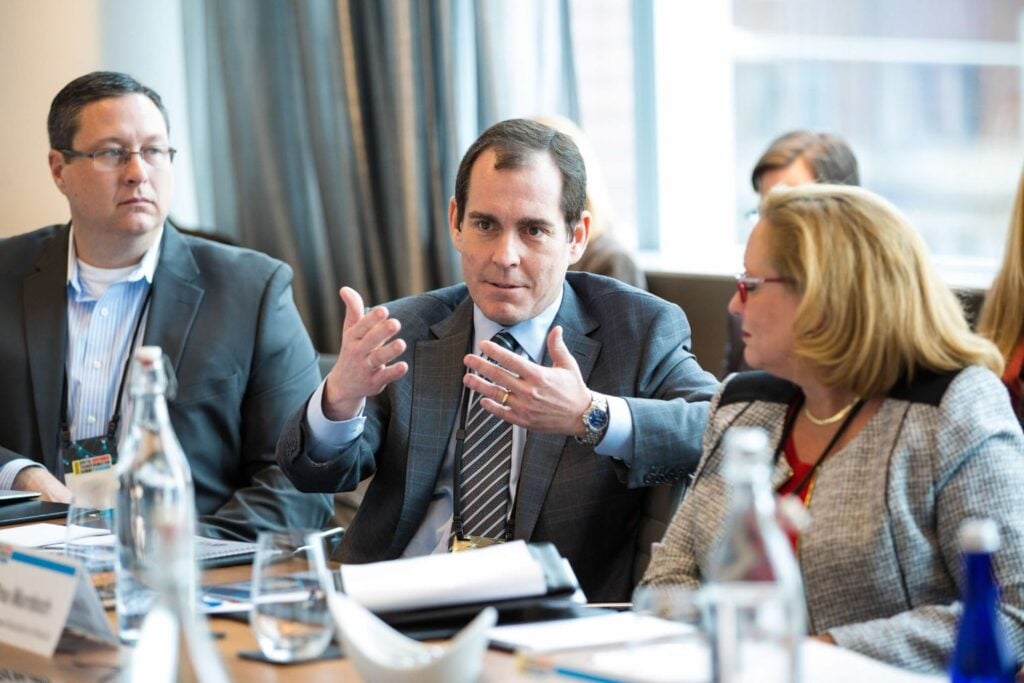
Three people in frame. Two men in the middle and left side, both wearing suits. Woman on the right wearing a tweed blazer.

Peer Exchanges

Real questions. Real pressures. Real peer insight.

Come ready to share challenges, compare oversight strategies and trade lessons with peers navigating similar pressures.

Audit Committee Exchange

From evolving disclosure requirements to AI risk oversight, the audit committee’s scope continues to expand—while expectations around accuracy, ethics, and internal controls have never been higher. This off-the-record session gives audit chairs and members a chance to compare approaches to managing external auditor relationships, cybersecurity readiness, audit committee workloads, internal reporting, and emerging financial risk.

Compensation Committee Exchange

Today’s comp committees are under increasing scrutiny—not only for pay-for-performance alignment, but also for how executive incentives reflect evolving priorities around risk, culture, human capital, and long-term value creation. In this session, compensation committee members and chairs will exchange views on evolving incentive structures, performance metrics, DEI-related targets, shareholder engagement, and how comp intersects with succession planning and CEO evaluation.

Nominating & Governance Committee Exchange

With heightened focus on board composition, refreshment, committee mandates, and ESG-related responsibilities, the nominating & governance committee plays a critical role in shaping long-term board effectiveness. This session offers committee members a private forum to discuss recruitment strategies, onboarding and director education, committee evaluation practices, shareholder expectations, and how to evolve governance practices to stay ahead of risk and disruption.

Chairmen & CEOs Exchange

Whether you’re a non-executive chair, lead director, or sitting CEO, this conversation is for the most senior voices in the boardroom. You’ll engage in a candid peer dialogue around topics like managing the board/management boundary, building trust across leadership transitions, ensuring alignment on strategy and risk, and leading through external pressure—whether from activists, regulators, or the media.

General Counsel Exchange

The GC’s role as board advisor and governance steward has never been more critical—or more complex. In this session, public company GCs will gather to discuss boardroom dynamics, director engagement, disclosure challenges, regulatory developments, and how legal teams are helping boards navigate emerging areas of risk like AI, cyber, and ESG litigation. A private, practical forum to sharpen judgment and compare strategies with those who walk the same tightrope.