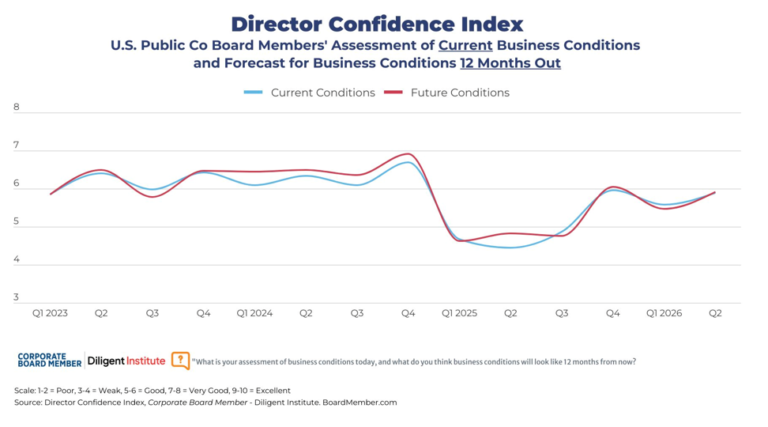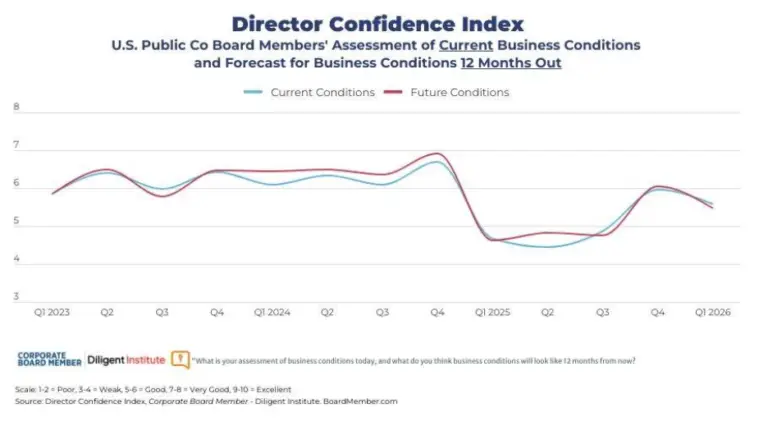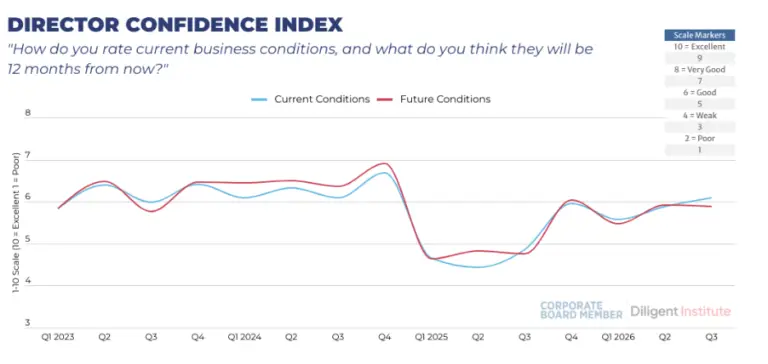
Boardroom Optimism Cools In Early 2026 Amid Uncertainty of War With Iran
Trade tensions, a new Gulf war and White House policy uncertainty weigh on directors’ outlook—but most remain confident their boards can navigate the risks.
Launched in the third quarter of 2020, the Director Confidence Index is America’s first ongoing pulse survey of public company board members on their perspective of the economy and how policies and current events are affecting the companies they oversee. Every quarter, Corporate Board Member and Diligent partner to ask thousands of public company directors the same three questions regarding their confidence in the current business environment, their outlook for the economy 12 months from now, and their projections for their board company’s revenue, profit and capex for the year ahead. Supplementing those three questions are questions on current events, as they pertain to corporate strategy and governance.
Participation in the poll is reserved exclusively for directors of publicly traded companies, across all sectors and market capitalizations.
The survey only remains open for 48 hours, thus making for a very timely assessment of sentiment. The data is then compiled and analyzed to establish trends and calculate the Index’s weighted averages. The results are released in the following days on boardmember.com, with exclusive comments and insights from participating directors. Unless otherwise explicitly agreed upon by the respondent, all responses are kept confidential to allow board members to share their perspective in a respectful, truthful, unbiased and collegial setting.

Trade tensions, a new Gulf war and White House policy uncertainty weigh on directors’ outlook—but most remain confident their boards can navigate the risks.

After three quarters at a five-year low, director confidence jumped 23 percent in December—yet the outlook for 2026 remains muted. One director’s advice: ‘Defend and survive.’

Survey finds a growing number of public company directors forecast flat growth for the rest of the year, despite new tax cuts. The big opportunity? AI adoption.