

Findings from the 2026 What Directors Think survey and the latest Director Confidence Index, both conducted by Corporate Board Member and Diligent Institute, show directors moving toward more continuous, forward-looking governance—even as gaps remain between ambition and practice.
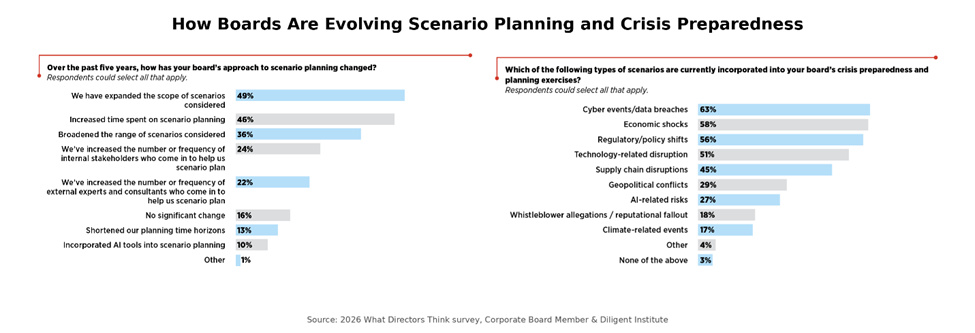
On one hand, 84 percent of the 200+ public company board members surveyed as part of the 2026 What Directors Think program say their boards have changed their approach to scenario planning over the past five years, expanding the scope and breadth of scenarios, increasing the time devoted to them and bringing more voices into the conversation.
Boards are now more likely to stress‑test strategy against economic shocks, regulatory shifts, cyber events, supply chain disruption, technology‑related disruption and AI‑related risks than in prior years.
Yet the mechanics of board work haven’t fully caught up with this expanded risk lens. Fewer than half of directors say they regularly receive real‑time or near‑real‑time operational performance data between meetings. Only about 12 percent say their meetings are “mostly forward‑looking,” with the majority still balanced or tilted toward retrospective reporting.
Our latest Director Confidence Index tells a similar story. In Q1 2026, directors’ rating of current business conditions fell from 6.0 to 5.6 out of 10, and their 12‑month outlook slipped from 6.0 to 5.5, signaling tempered optimism amid tariffs, trade policy uncertainty and geopolitical risk.
Even so, 73 percent say they are quite or very confident their board is equipped to oversee the risks and opportunities ahead—a degree of confidence many are backing up by changing how they monitor risk between meetings.
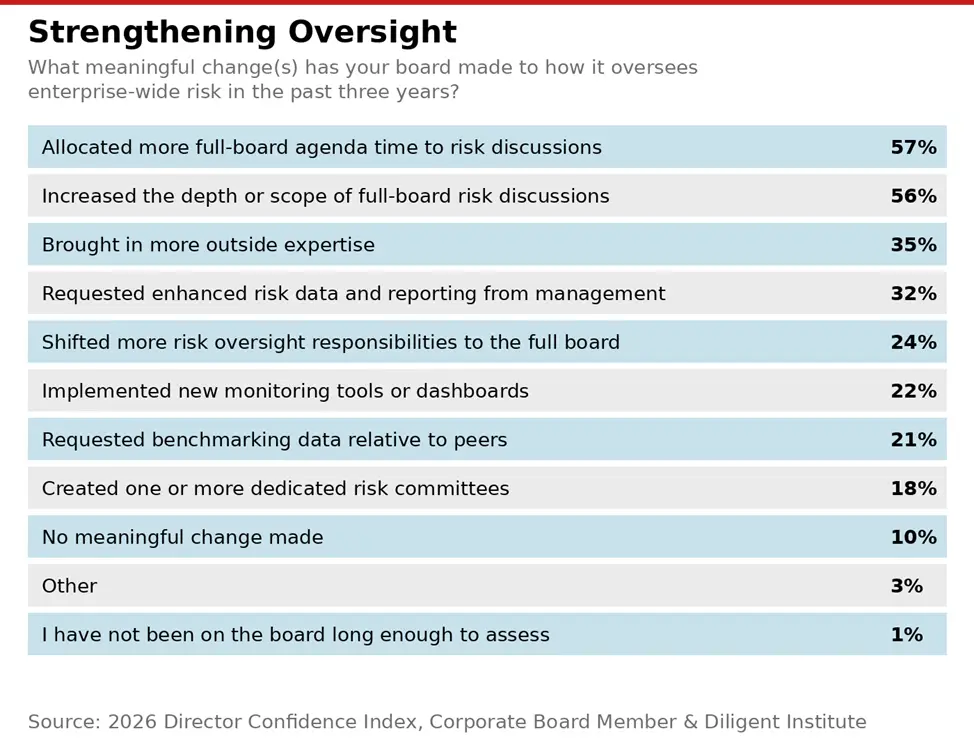
Roughly half of directors polled report allocating more full‑board agenda time to risk and increasing the depth of those discussions, while about a quarter say their boards have introduced new monitoring tools or dashboards, including AI‑enabled tools, and have shifted more risk oversight responsibilities up to the full board. Only 10 percent say their board has made no meaningful changes to its risk oversight approach in recent years.
Taken together, these findings point to a clear evolution: Risk oversight is becoming a continuous, enterprise‑wide discipline, rather than a quarterly checklist item, but many boards are still modernizing the data and processes needed to sustain that shift.
Designing a More Future‑Focused Board Agenda
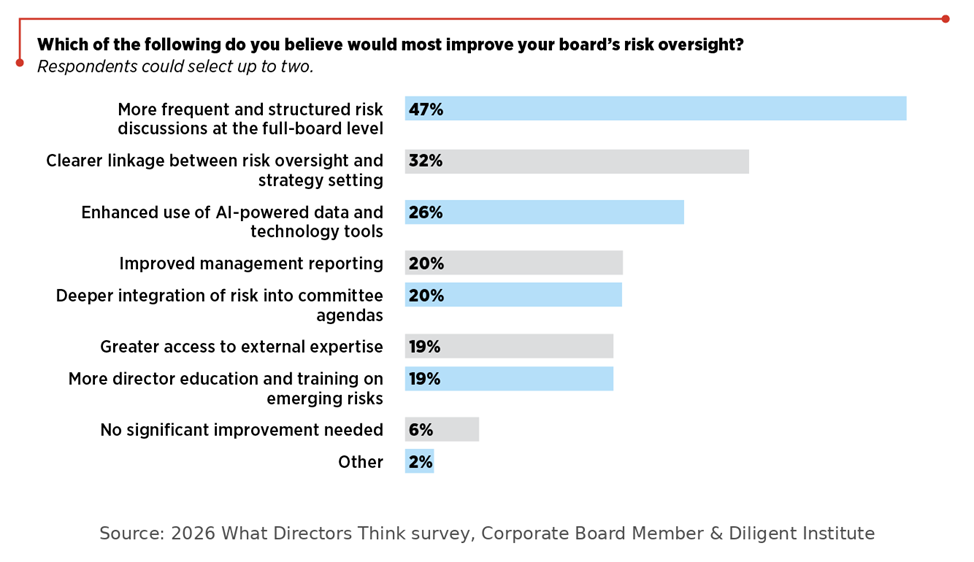
When invited to optimize the broader governance process, directors return to the same theme: more time on what’s ahead. Fifty‑eight percent would add more time or dedicated meetings for strategic planning, and 42 percent would cut back on presentations in favor of deeper discussion.
Nearly half want greater exposure to outside experts, and 40 percent specifically want access to AI‑powered technology for board work and oversight—a signal that directors are hungry for richer, more forward‑looking insight streams, not just thicker board books.
For many boards, that means rethinking the cadence and structure of meetings. Practical moves emerging from the data include:
- Rebalancing agendas so that backward‑looking financial and operational reporting is streamlined, freeing more time for strategy, scenarios and emerging risks.
- Embedding scenario planning as a standing practice—rather than an annual exercise—focused on economic shocks, regulatory shifts, technological disruption, cyber events and AI‑related risks.
- Using dashboards to handle routine reporting, reserving live time for probing management assumptions, and testing resilience under multiple futures.
Turning AI and Data into a Governance Advantage
AI sits at the center of this transition. “Deploying AI technology across the business” ranks among the top organizational priorities in 2026, and technology adoption and integration is the leading capital investment focus, cited by 42 percent of directors.
At the same time, half of directors expect AI and technology‑related regulation to demand the greatest compliance attention in 2026, and 41 percent say it is the most underestimated compliance risk boards face today.
Despite that focus, AI has yet to be fully integrated into risk oversight. Only 3 percent of boards say AI is extensively embedded in their risk oversight and decision‑making, and just 20 percent report using AI regularly alongside traditional approaches; a full 40 percent say they are not using AI at all in this context.
For boards seeking to move toward continuous, forward‑looking governance, the implication is straightforward: AI should be treated as a decision‑support layer for governance, not just a business‑unit experiment. That means:
- Asking management to integrate AI‑driven risk and performance indicators into existing dashboards.
- Using those insights to support more frequent, shorter touchpoints between meetings when indicators spike or scenarios shift.
- Ensuring the board has appropriate policies and guardrails around AI use—particularly as directors begin to use AI tools directly for board work.
Composition and Culture for Always‑On Governance
Finally, a more continuous, forward‑looking model of governance depends on who is in the room—and how they work together.
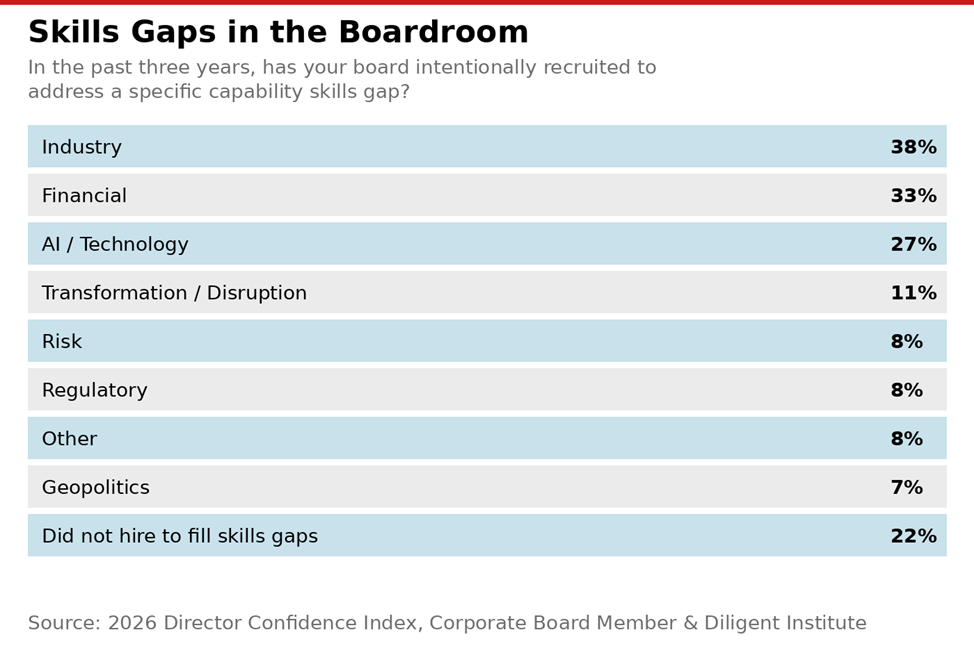
“AI expertise” has emerged as a top attribute boards want from their next director appointment, cited by 28 percent of respondents, even as only 8 percent say their boards currently have strong AI expertise, the lowest level across all domains surveyed.
Directors also prioritize industry‑specific, financial and business expertise, reflecting a desire to pair technology fluency with operational depth.
Our data shows many boards are already acting on those priorities: Over the past three years, more than a quarter have added AI or technology capability specifically to address skills gaps.
Taken together, the findings are clear: Boards are already moving toward more continuous, forward‑looking governance, but the next phase will demand bolder changes to agendas, data, tools and talent.
Boards that successfully make this shift will treat risk oversight as an ongoing discipline, not a quarterly ritual; harness AI and real‑time data as core inputs to their deliberations; and ensure the right expertise is in the room to challenge assumptions and connect dots across a more volatile landscape.