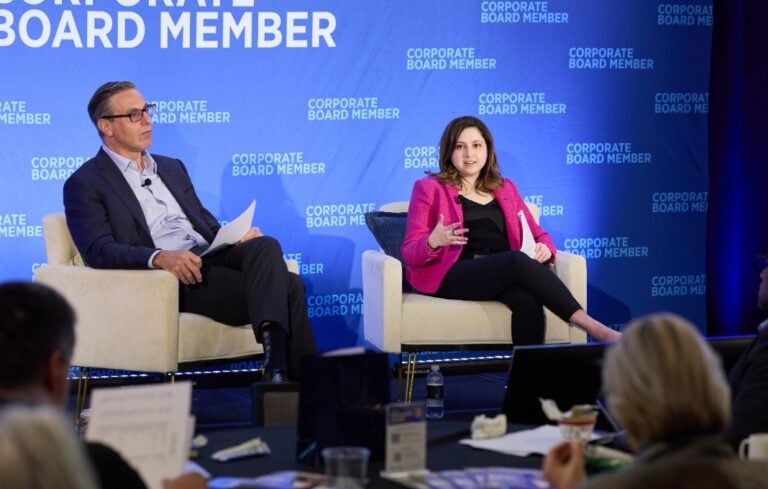


Boardrooms risk flying blind if they treat today’s turmoil as a passing storm rather than a structural reset, making high‑stakes decisions while the rules of globalization, technology and power are rewritten in real time.
In the following interview, Lynn Miteva, chair and CEO of Miami‑based Kizoku Media, describes how her board uses geopolitical literacy, AI fluency and narrative intelligence to read weak signals, anticipate system‑level shifts and govern through volatility instead of reacting to headlines.
For directors, her approach offers a practical playbook: recruit people who can interpret complex global dynamics, integrate AI without surrendering judgment and design organizations built to operate inside instability rather than waiting for “normal” to return.
What are some of the most pressing topics your board is tackling these days?
At Kizoku Media, the most urgent issue we face is the profound realignment of the geopolitical, economic and technological systems that have governed the last two decades. This is not the 1950s or 1980s; today’s landscape is far more entangled, and the Western and Eastern worlds have never been so interconnected—or so competitive.
The global system built over the last 10 to 15 years was not efficient; it was a fragile arrangement of artificial stability, distorted incentives and unrealistic dependencies. What we are witnessing now is the predictable recalibration of an overstretched system.
Our board is focused on understanding this transition as a systemic pattern, not an anomaly. I experienced similar dynamics during the perestroika era in the 1990s: What looks like chaos is often the early stage of a new equilibrium. This time, however, the adjustment is more complex, because neither side of the geopolitical divide is willing to yield ground—economically, technologically or ideologically.
For us, the pressing topics are geopolitical fragmentation, the weaponization of narratives, AI acceleration, deglobalization and the rise of strategic competition across every industry. We examine not just headlines but systemic signals—the deeper currents that shape markets, leadership and long-term decision-making.
How are you mitigating some of your company’s toughest challenges?
Our toughest challenge is building a company that can operate inside a system undergoing stress, fragmentation and continuous recalibration. We mitigate that by treating strategy as a living system, not as a fixed plan. We map geopolitical signals, economic patterns, narrative shifts and technological disruptions as interconnected variables rather than isolated events. This helps us anticipate second- and third-order effects long before they hit the mainstream.
One of our core tools is ontological modeling—understanding how information, perception and behavior interact. Because we operate at the intersection of AI, media and political economy, we cannot afford reactive decision-making. We run constant scenario testing, stress-testing assumptions the way financial institutions stress-test portfolios.
We also actively reduce dependency on single technologies, single markets or single narratives. A major part of our resilience strategy is diversifying talent, data perspectives and strategic inputs so we are not locked into one worldview.
Finally, we embrace a philosophy most companies avoid: friction is information. Instead of treating challenges as disruptions, we treat them as signals that the system is revealing its next phase. This mindset turns uncertainty into strategic advantage and allows us to move when others hesitate.
What’s new about how you are recruiting board members?
We’ve radically redefined what qualifies someone to sit on our board. Traditional boards are filled with industry veterans who understand their domain but lack literacy in geopolitics, economics and systems thinking—which, in today’s world, means they are making decisions in the dark.
At Kizoku Media, we only bring in leaders who understand political economy, technological acceleration and macro-system dynamics. In today’s environment, if you don’t grasp what’s happening geopolitically, you cannot make meaningful strategic decisions.
We look for intellectual independence, pattern recognition and the ability to interpret weak signals before they become crises. We value individuals with interdisciplinary experience—people who understand finance, technology, media, governance and global power structures.
We also avoid people who rely entirely on consensus thinking. The last 10 to 15 years created an illusion that strategy was simply about optimization and cooperation. That era is over. The people we bring in must be comfortable working in ambiguity, recognizing structural shifts and making decisions without prescribed playbooks.
In short, we recruit board members who think like strategists, not administrators—individuals who understand the world as a dynamic system and can guide a company through volatility, competition and accelerated technological change.
How does your board keep up with the opportunities and risks of emerging technologies?
Our board approaches emerging technologies through a unified framework: technology, geopolitics, economics and narrative influence are inseparable. We evaluate every innovation—especially AI—not only for its capabilities, but for the political, economic and societal consequences it will trigger. Because Kizoku Media operates at the intersection of AI and narrative systems, we treat technology as a strategic variable, not a trend.
While much of the world reacts to “AI this, AI that” with hype, we’ve been working with AI since well before it became a mainstream talking point. I trained AI models myself starting in 2022, long before the public acceleration of 2023 and 2024. That experience taught us something most companies still don’t understand: AI is powerful, but it is not a substitute for judgment, geopolitical literacy or strategic foresight.
We keep pace by integrating technical experts, economists, political analysts and narrative theorists into our decision-making process. We track not just technological capabilities, but how states, corporations and networks weaponize or regulate them.
Our goal is not to chase every new technology, but to determine which ones fundamentally shift the rules of the system—and then position ourselves ahead of that shift.
What are your strategies to ensure your company remains resilient?
Resilience for us is not about stability—it’s about adaptability, structural awareness and strategic optionality. We assume the environment will remain volatile. Instead of hoping for a return to “normal,” we design the company to operate inside instability.
Our first strategy is systemic literacy: understanding how political, economic, technological and narrative systems interact. When you can see the pattern behind the noise, you stop reacting and start anticipating.
Second, we build resilience by diversifying perspectives, tools and strategic pathways. We avoid dependency on single technologies, markets or partnerships. We develop parallel options so that if one system shifts, we can pivot without losing momentum.
Third, we maintain a culture where dissent is a strategic asset. Resilience requires people who challenge assumptions, detect weak signals and are willing to voice uncomfortable truths early.
Finally, we integrate AI as an augmentation tool, not an authority. AI helps us map narratives, identify system stress points and model alternative scenarios—but human judgment, especially geopolitical and economic judgment, remains the core of our decisions.
Resilience today is about being aligned with reality, not comfort. The companies that survive the next decade will be the ones that understand the system, not the ones that wait for it to calm down.