

For all the pressure on companies to invest in artificial intelligence, most public company directors say their boards aren’t planning to make AI outcomes part of the CEO pay package.
At least not yet.
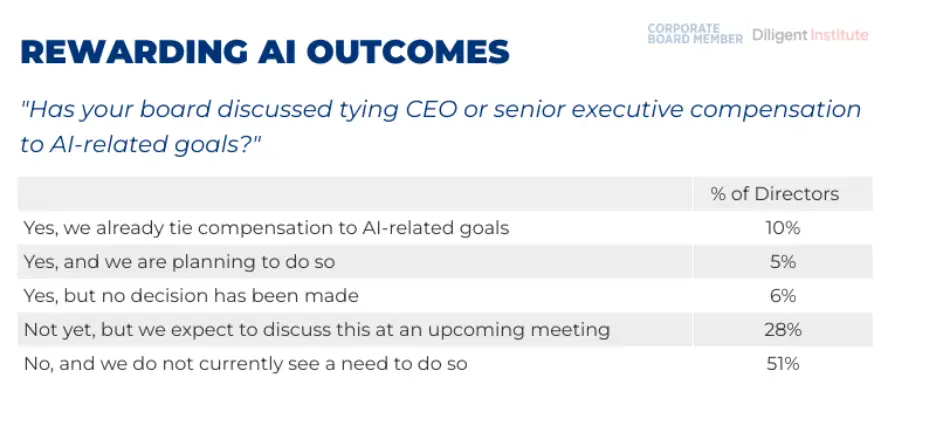
More than half—51 percent—of directors surveyed by Corporate Board Member and Diligent Institute the last week of August say their boards have not discussed tying CEO or senior executive compensation to AI-related goals and currently see no need to do so.
Just 10 percent say their companies already tie compensation to AI-related goals, with financial services companies leading the pack: directors from the sector account for more than a third of those who say AI goals are already part of their executive compensation plans.
Another 5 percent of directors polled say their boards have discussed incorporating AI-related metrics into compensation plans and intend to do so in the near future. Six percent have discussed the idea but have yet to make a decision.
Still, the issue is beginning to make its way onto board agendas. Twenty-eight percent say they haven’t discussed AI-linked compensation yet but expect to at an upcoming meeting.
“AI shouldn’t be rushed into compensation plans,” says Dottie Schindlinger, executive director of the Diligent Institute. “The important question to answer first is whether boards can clearly define and measure progress on AI-related goals so that they could hold executives accountable to them.”
THE METRICS THAT MATTER
When asked what kinds of AI-related performance they would consider tying to their executive compensation plan, directors seemed more inclined to opt for tangible business results.
Among those open to linking AI and executive pay, 82 percent say they would consider productivity or efficiency gains, by far the most frequently selected measure.
Financial return or ROI from AI investments follows at 57 percent, while 52 percent would consider revenue growth or new business generated through AI. Half would consider workforce transformation or reskilling.
Forty-three percent would consider AI governance, risk or compliance, while 40 percent selected customer-related outcomes. By comparison, just 38 percent would consider the successful implementation or adoption of AI itself.
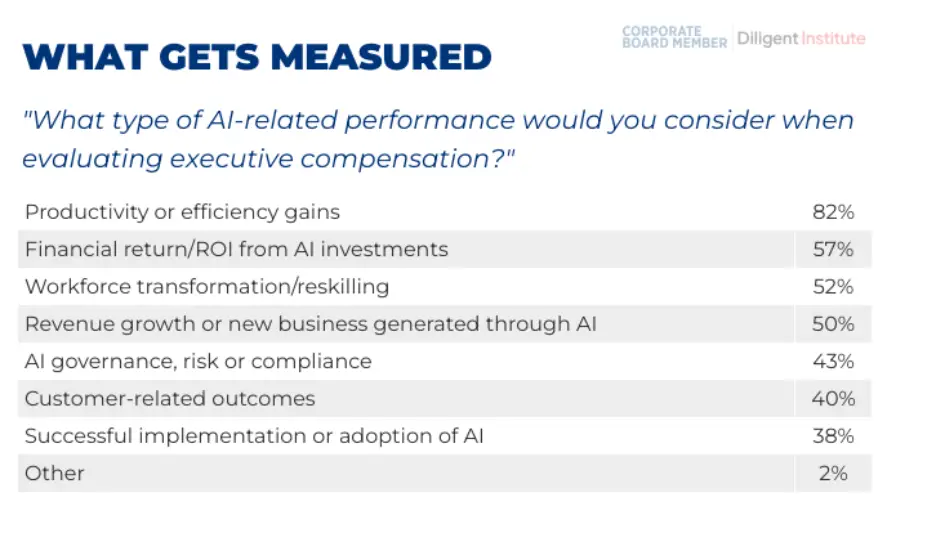
The responses indicate boards are less interested in using AI deployment itself as a compensation metric than in seeing evidence that those investments are translating into greater productivity, stronger financial results or meaningful changes in how the workforce operates.
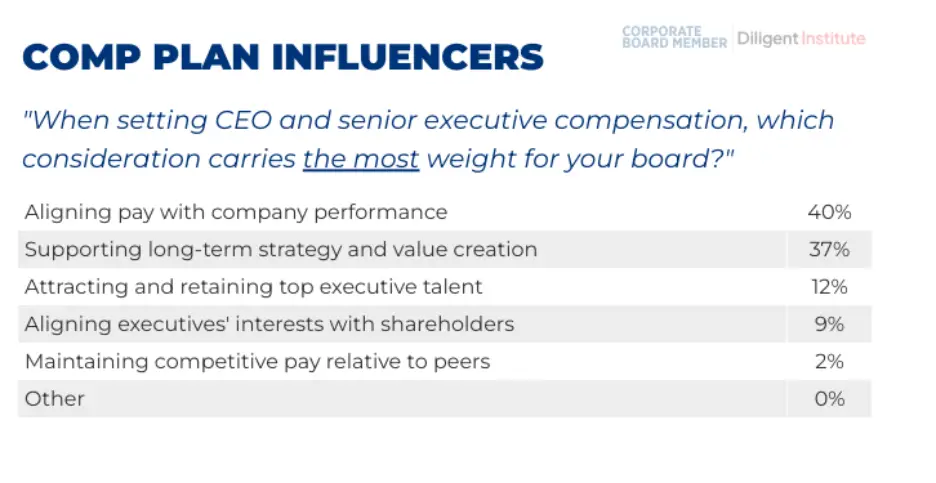
That approach is consistent with how directors say compensation plans should work more broadly: 40 percent say the most important consideration when setting CEO and senior executive compensation is aligning pay with company performance, the top response. Nearly as many—37 percent—say supporting long-term strategy and value creation should carry the most weight.
Far fewer prioritize attracting and retaining executive talent, aligning executives with shareholders or maintaining pay levels relative to peers.
Taken together, the findings suggest boards are applying a similar test to AI: whether the investment ultimately translates into measurable company performance or longer-term value.
“The data points to a potential challenge: No single metric will capture AI’s full impact,” says Kira Ciccarelli, senior manager of research at Diligent Institute. “Boards need a balanced approach to reward sustainable progress over longer periods of time.”
WHEN BOARDS STEP IN
The focus on results also shows up when directors consider whether boards should override an existing incentive plan and reduce executive compensation.
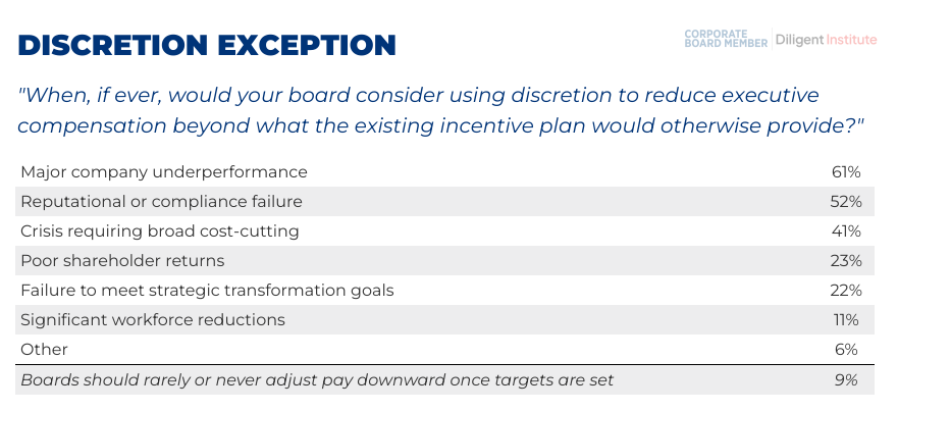
Sixty-one percent say major company underperformance could justify using discretion to cut pay beyond what the incentive plan would otherwise dictate. Reputational or compliance failure is the only other circumstance selected by a majority, at 52 percent.
Other events draw considerably less agreement: 42 percent cite a crisis requiring broad cost-cutting, while fewer than a quarter point to poor shareholder returns or failure to meet strategic transformation goals. Just 11 percent cite significant workforce reductions.
A DIFFERENCE OF OPINION
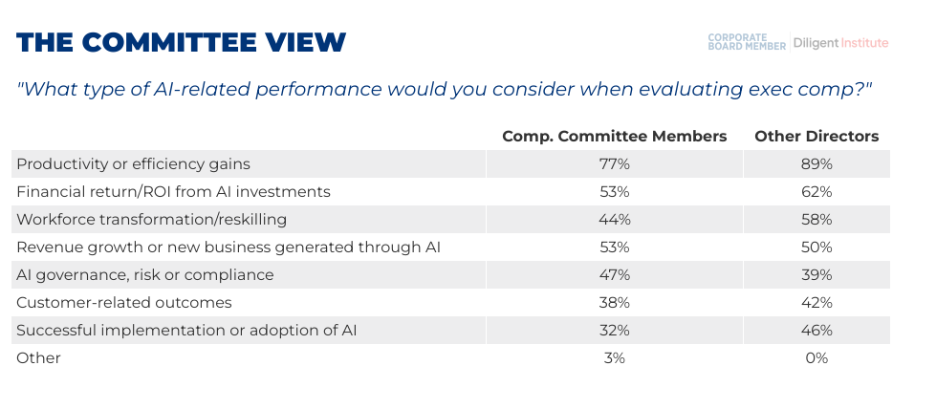
Of course, not all board members agree—and the difference seems to depend on how close you are to compensation.
Our survey found that compensation committee members are less likely than others to cite productivity gains, ROI, workforce transformation or successful AI adoption as potential compensation metrics. They are somewhat more likely to consider revenue growth and AI governance, risk or compliance.
That broader perspective carries over to compensation philosophy as well. Compensation committee members are more likely to put greater weight on executive retention and shareholder alignment, rather than concentrating as heavily on company performance and long-term value creation.
Company size creates another divide.
Directors at larger companies (those with at least $1 billion in revenue) are more focused on financial returns: 69 percent would consider financial return or ROI from AI investments when evaluating executive compensation, compared with 30 percent of directors at smaller companies. Productivity or efficiency gains remain the top consideration across both groups.