
Shauna McIntyre is a three-time CEO who has coached PE firms, helped Google build out its auto business and even stood up a mobility practice for talent advisory titan Egon Zehnder once upon a time. Through all of that she’s learned that using pay as a retention tool can backfire. Badly. “It created a culture based on comp,” she says, “and it was just not the right culture, not the right tone I wanted to set.”
Now, as chair of the compensation committee of Lithia Motors, one of the largest automotive retailers in the world, McIntyre says that when it comes to succession strategy, “comp is just not a discussion point… And I’m glad it’s not because it really is about the talent; it’s about the expertise; it’s about the capabilities—the potential.”
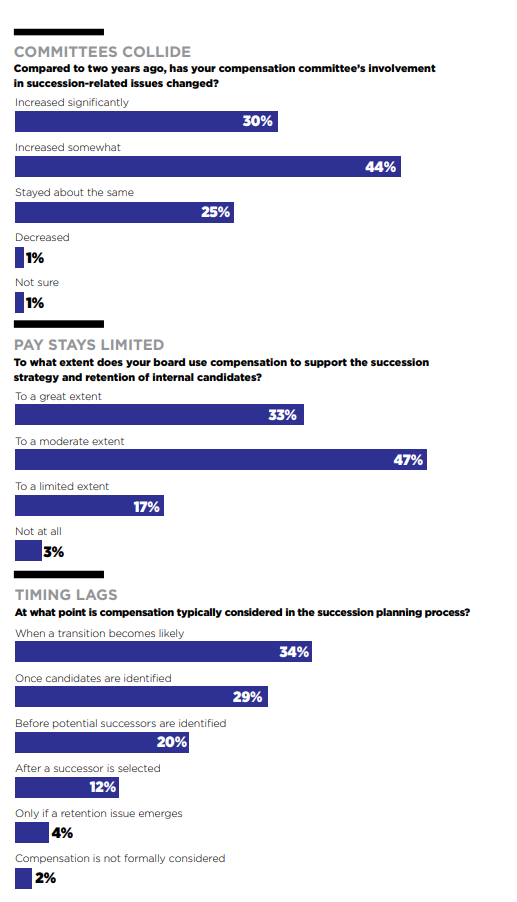
She’s far from alone. When it comes to retaining top talent, money has its place. But it isn’t first place, at least not according to Corporate Board Member’s latest research with Farient Advisors. In a survey of 131 public company directors serving on boards of U.S. companies with $1 billion or more in revenue, roughly three-quarters said their compensation committee’s involvement in succession-related matters has increased over the past two years. Yet only a third say their board uses compensation “to a great extent” to support succession strategy and the retention of internal candidates; 64 percent say it is used only to a moderate or limited extent.
For good reason. “If you’ve gone through the process to benchmark your overall compensation programs, and you’ve consulted with the compensation consultants and experts, and you’ve kept an eye on what your peers are doing, it may not be necessary to use the carrot because you should have designed it into the structure,” explains Thaddeus Malik, who serves on CenterPoint Energy’s nom/gov and audit committees.
Robin Ferracone, CEO of Farient Advisors, our partners on this research, says that shift moves compensation committees beyond a narrow pay lens and into a broader talent-risk oversight role. “The real opportunity is not to use compensation as a last-minute fix but to understand where succession, retention, readiness and rewards intersect well before a succession event occurs,” she says. “Compensation can be a powerful tool, but only when it is connected to a clear talent strategy.”
The same framework applies to retaining talent. “It’s not just about retention grants,” she says. “It’s about planning holistically and longitudinally around role, development experiences, realizable pay potential upon the achievement of good results and the internal hierarchy of pay.”
THE RIGHT ARCHITECTURE
That doesn’t mean boards are trying to remove compensation from succession planning entirely.
Meg Ann Divitto, who serves on both the governance and compensation committees at LKQ Corporation, says a lot of companies are overhauling their comp plan to account for special occurrences. “From a succession planning perspective, we expect that the comp plan is competitive, is designed correctly, and we’re relying on that having a larger aperture, a more holistic view to say, ‘Okay, there is room in our current well-designed comp plan if we need to pull certain levers as it relates to succession,’” she says.
That can include a pool of grants for executives taking on more in preparation for promotion, with awards tied to “results, productivity, meeting expectations of that newly created role,” she says. “That’s where I think it has a benefit.”
Brian Tyler, chair and CEO of McKesson and an independent director at Republic Services, draws the same line from the CEO seat. Compensation can be a retention tool, he says, but not as a reflexive response to an outside offer. “It is a tool that I have used, but I use it much more proactively, not in the moment of, ‘Oh, someone’s got an offer, I need to respond to it,’” he says.
Used that way, compensation can send “a very counterproductive signal” to the organization: “Hey, you guys should all go out and look for jobs because that’s the best way to get a raise at McKesson.” The better use, he says, is continuity: “It’s more for organizational stability than reacting to a point in time… By then, to me, it’s a bit too late.”
Jesús Mantas, chair of Biogen’s comp committee, makes a similar argument, starting from the premise that compensation has limits as a motivator. Once executives believe they are fairly paid, he says, the board’s challenge becomes designing incentives without encouraging the wrong behavior. “The main role of compensation on the board is to balance short-term and long-term goals in a way that doesn’t create perverse incentives,” he says. That makes timing critical. Compensation, as a factor in succession, “has to be before anybody is ever a candidate for the succession, not as a result of being a candidate,” Mantas says. “The failure of compensation policies is if anybody ever [has] to say, ‘I’ll give you a raise now because you threatened to leave.’ You should have given that raise before that person ever had a motivation to leave.”
For Mantas, the test is simple: “When this person gives notice tomorrow, if they ask us for $100,000, would we give it to them?” If the answer is yes, he says, “then give it to them today. Don’t wait.” And if, having been paid fairly, they still decide to leave? “The policy should be: We would hope you would stay, the best of luck, and we’re glad that we create great talent for other people.”
The real succession lever, he says, is the work that comes before a retention crisis: leadership development, stress testing and opportunities to assess whether candidates will be successful before they are put in the job.
WHEN PAY BELONGS
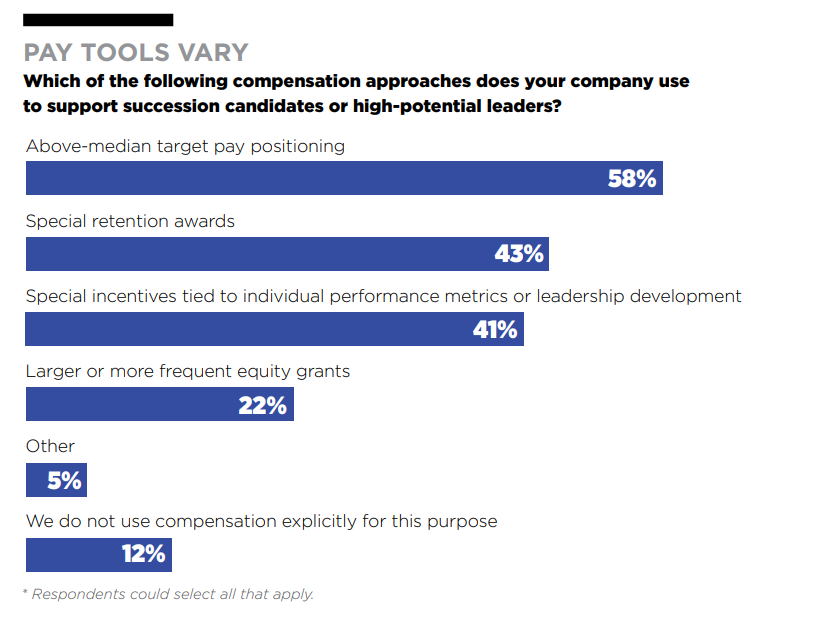
When boards do use compensation as a retention tool, it is rarely the only or most prominent move. The survey suggests pay is more often considered alongside development, expanded responsibilities and a clearer future path.
For Vanessa Allen Sutherland, an independent director at Dominion Energy and executive vice president and chief legal officer at Fortune-50 Phillips 66, the question is not whether compensation should be used, but whether the board is making a deliberate distinction between those it can afford to lose and those it cannot.
“If someone is actually so valuable but maybe they’re not ready yet… We will, in fact, talk about a retention agreement. We will, in fact, talk about whether we might do an employment arrangement with this person that is both compensation and a true retention agreement but also give them specific training plans,” she says.
In her experience across multiple public company boards that include Eastman Chemical and Norfolk Southern, that package—dollars tied to a concrete development plan—signals that the individual’s future at the company is real, not consolatory. “We didn’t realize before today that you have this deficiency, which you’re really going to need as a CEO. So here are the three resources that we are going to give to you,” Sutherland explains. “I’ve seen very intentional efforts to retain the talent and to do that through both comp and professional development opportunities and activities to let them know: We still value you.”
KNOW YOUR BENCH
The ability to use compensation judiciously depends in part on how well the board knows the leadership pipeline. Only 18 percent of directors say their board’s succession planning fully extends beyond the CEO to at least two levels down. That depth requires direct exposure.
Eric Spiegel, a director at Dover Corporation and the former CEO of Siemens U.S., takes a structured approach: one-on-one meetings with next-level executives before each board meeting—no CEO in the room, no business presentations. “Talk to us about your career, where you’ve been, where you are now, what are your aspirations, what’s working well inside the company, what would you like to see changed,” he explains.
The conversations reveal things that would never come out in a formal board meeting, including direct signals about departure. “Sometimes they’ll just flat out say, ‘Look, if I don’t see an opportunity to move up here in the next two or three years, I’m going to start seriously looking,’” Spiegel says, acknowledging even the best-run companies will lose “good people.”
Sutherland says directors should also test the evidence behind the succession chart: personality assessments, 360-degree reviews, coaching work and how candidates have developed their own teams. Have likely successors been seen in enough settings to understand who they are outside a staged boardroom presentation? The rigor of those answers, she says, is where the real confidence—or the real gap—will show.
At Lear Corporation, that deeper view takes the form of an in-depth leadership review every August—hundreds of people assessed through manager evaluations and scientific tools, each receiving goals for the coming year. “If you’re a manager and you have no one who is a B or above on your team, we’re clear you’re not a good leader,” says Conrad Mallett, who has served on Lear’s board for more than 20 years.
The approach produced a board that knows its people well enough to not only support succession planning but also make judgment calls the market can’t always see. When Lear’s South American operation was underperforming and analysts were pressing for an exit, the board chose to stay—not on financial metrics alone but because they had sufficient familiarity with the leadership team on the ground. “We had met them. We understood their energy. Some of us had actually visited,” Mallett recalls. “Now, South America’s killing it.”
FROM CONFIDENCE TO EVIDENCE
Directors are broadly confident in their board’s use of compensation in succession planning: 52 percent said their company uses compensation “very effectively,” while less than 1 percent rated their approach ineffective.
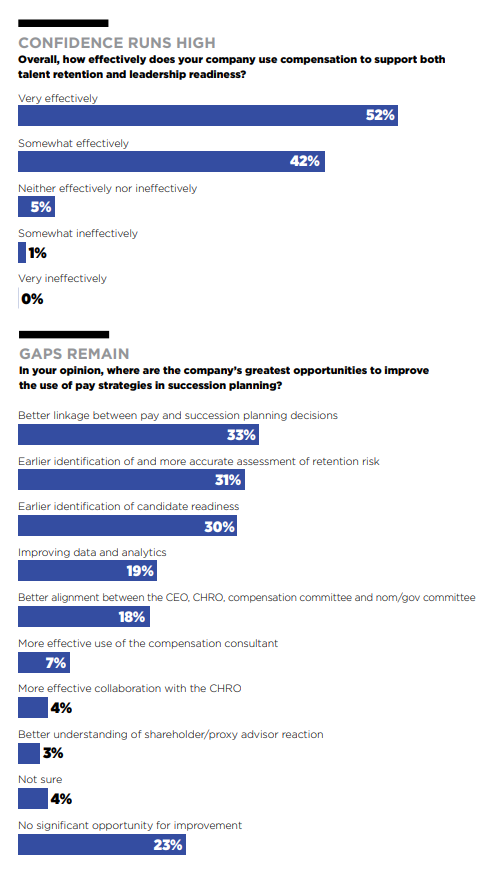
That confidence sits alongside operational challenges. Roughly a third of directors cited opportunities to improve linkage between pay and succession decisions, earlier identification of candidate readiness and more accurate assessments of retention risk.
Mantas says one place to start is with the committee agenda itself. “In many of the boards I see it’s 80/20—80 percent statutory and technical compensation decisions, 20 percent talent discussion,” he says. “I would immediately reshuffle that 50/50.”
He also wants a sharper view of the company’s most critical talent. “No matter the size of the company, [there are] no more than 100 people that basically are the most important for the value creation of the company,” he says. “I’d like to know who they are… What do they care about? Why are they staying? Why would they go?”
That is the kind of fact base R.J. Bannister, partner and COO at Farient, says boards need to move from confidence to evidence. If a company is preparing a cohort of executives for the top job—rotating responsibilities, expanding assignments and testing readiness—it may need to view those executives as a succession cohort, with comparable pay opportunities tied to readiness milestones and development experiences, rather than relying only on market pricing for their current jobs.
The goal, Bannister says, is to use data on executive vulnerability, holding power, replacement depth and transition costs to determine whether compensation is supporting the succession plan and broader talent agenda.