
Ask public company directors what the midterms mean for their companies and you’ll hear two sides of the same story. Neither has anything to do with party lines. One is what they expect. The other is what they’re doing about it.
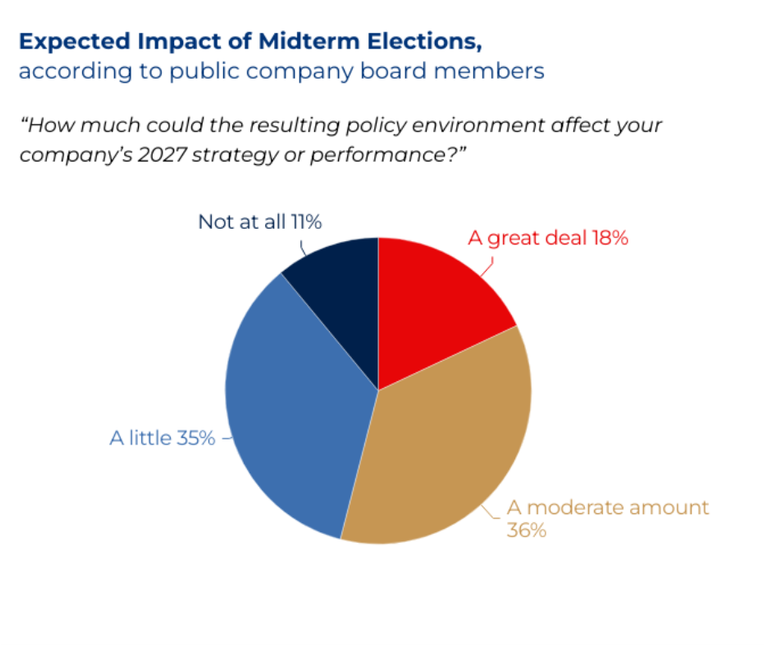
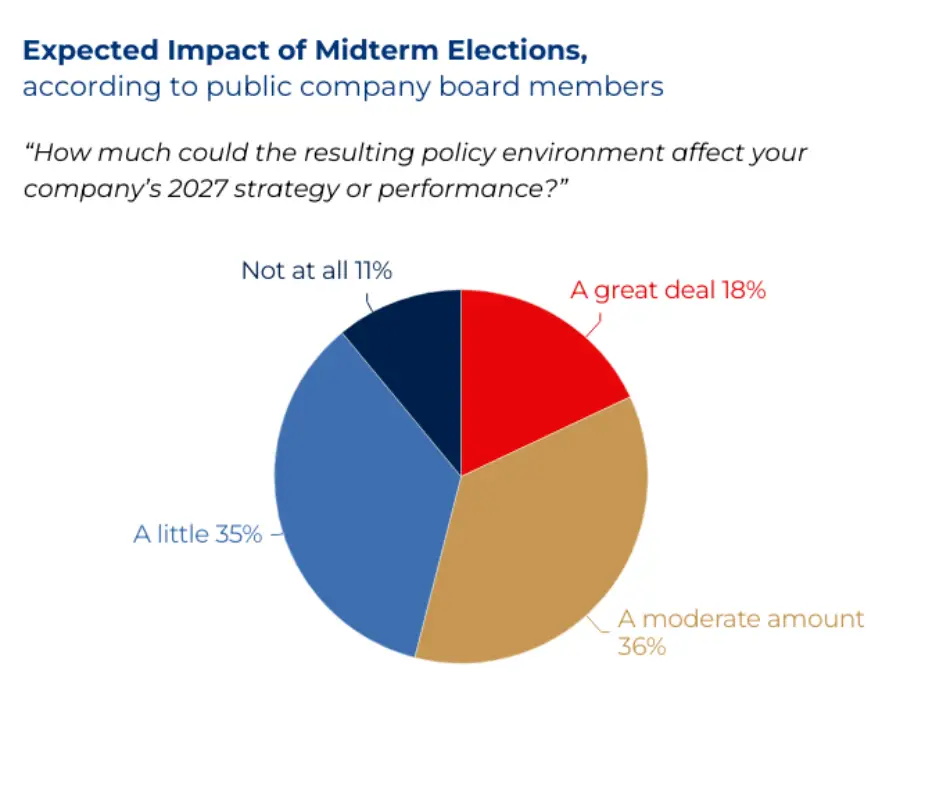
Early-release findings from Corporate Board Member’s What Directors Think 2027 research, conducted in partnership with Diligent Institute and FTI Consulting among 111 U.S. public company board members, find 89 percent expecting the resulting policy environment to have an effect on their company’s strategy and performance in 2027, with more than half—55 percent—expecting a moderate or great impact.
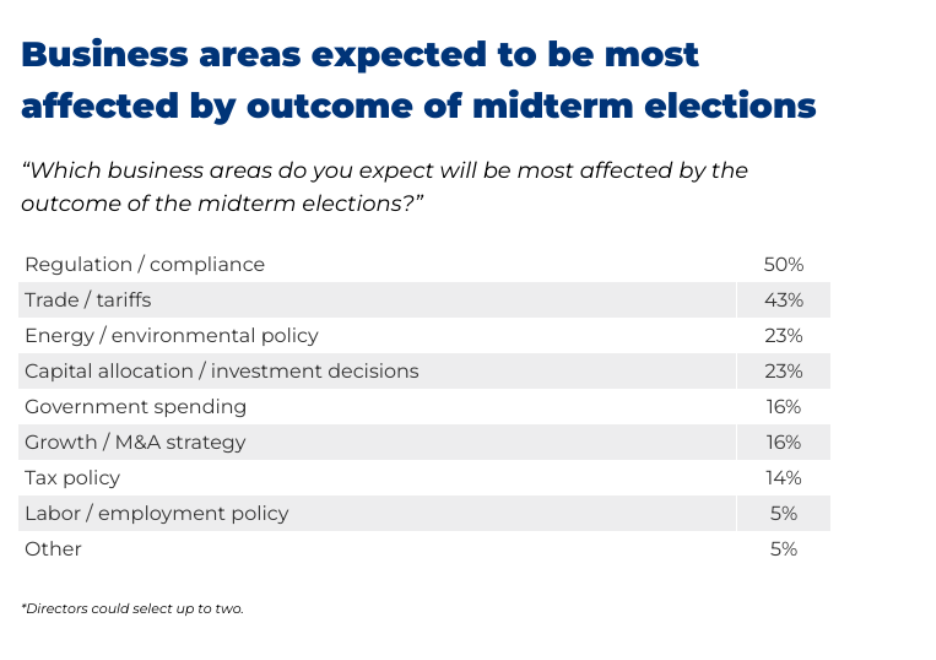
The biggest change expected: regulation. Fifty percent of surveyed directors expect regulation and compliance to be among the business areas most affected by the election outcome.
This is followed by trade and tariffs, at 43 percent.
After that, the numbers fall sharply: 23 percent cite energy and environmental policy and 23 percent capital allocation and investment decisions. Government spending, growth and M&A strategy, tax policy and employment policy rank lower still.
Building Optionality, Not Overacting
Some boards are already preparing for the change: refinancing early, shoring up balance sheets, diversifying supply chains, stepping up government relations and political engagement.
Others, roughly a quarter, are holding still, convinced, as one director put it, that “nothing will change overnight, if at all.”
Many sit somewhere in between, running scenarios, developing contingency plans and identifying the triggers that will tell them when to act.
“More aggressive scenario planning,” one director said. “The amplitude of potential moves is wider.”
The findings align with broader trends in the boardroom. In the 2026 What Directors Think research, 84 percent of directors said they had strengthened their scenario-planning approach in some way, 58 percent had added economic shocks to their exercises and 56 percent had incorporated regulatory policy shifts.
“That kind of preparation helps boards turn uncertainty into practical options,” says Dottie Schindlinger, executive director of the Diligent Institute.
Boards eyeing deals in 2027 also shouldn’t leave M&A out of their scenario planning. “In the wake of the midterms, boards should expect greater regulatory scrutiny and higher costs tied to compliance, government relations and lobbying,” says Brian Kushner, senior manager and practice lead at FTI Consulting and a director at Resideo Technologies. “This means building regulatory and political uncertainty directly into deal scenarios.”
Several directors described the same basic approach: preparing alternative paths that can be activated depending on what happens next. That optionality allows boards to create room to move without committing too early.
Bigger Companies, More At Stake?
Among directors serving companies with $10 billion or more in annual revenue, 37 percent say the post-election policy environment could affect their company’s 2027 strategy or performance ‘a great deal,’ compared with 12 percent of directors at smaller companies.
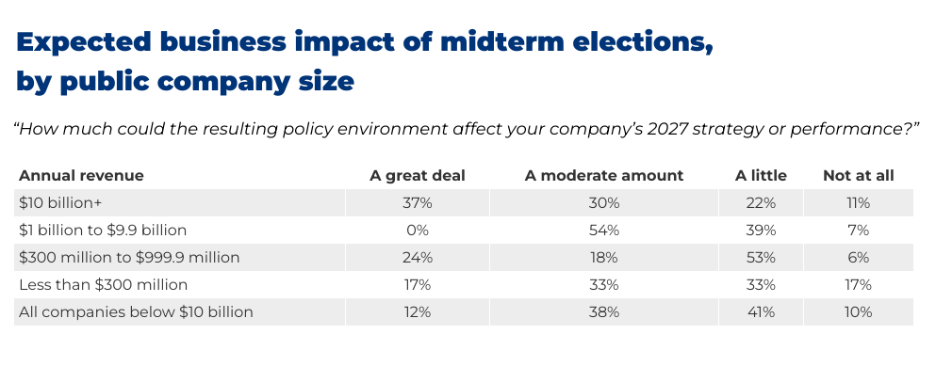
Larger companies often have greater international exposure, more regulatory touchpoints, broader supply chains and more sensitivity to capital markets and government policy, which would help explain that gap. And last week’s polling of CEOs by sister publication Chief Executive offers a window into that reality.
Among the 435 CEOs participating in the November CEO Confidence Index poll, those at public companies, which tend to be the largest in the sample, offered a gloomier read on business conditions than their private peers, rating current conditions 4.9 out of 10, vs. 5.3, and forecasting conditions would improve to 5.1 a year from now, vs. 5.4 among private-company CEOs.
The election results also deepened the gap. Among all CEOs who responded to the poll after election results began coming in during the evening of November 3, expectations strengthened—but looking only at CEOs of publicly traded companies, confidence remained more restrained even after the election results came in.
Watching What Comes Next
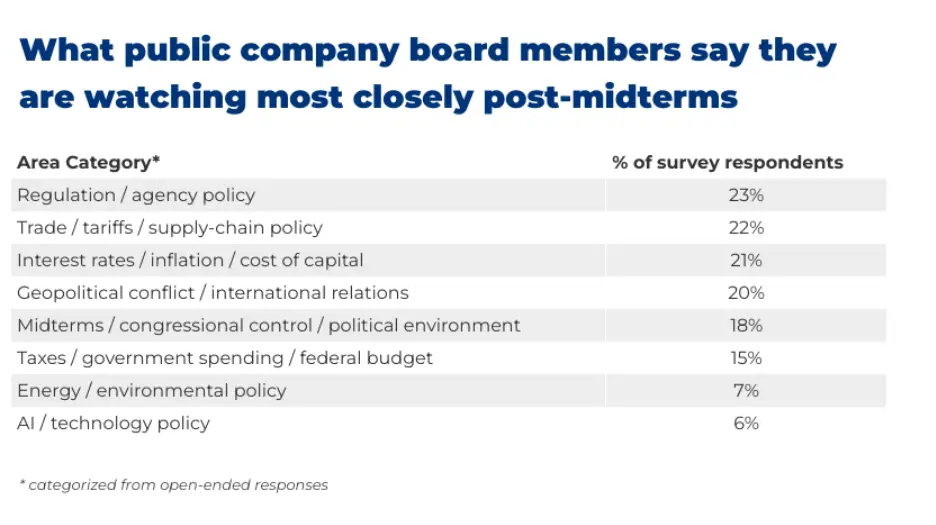
Asked what economic or political development they are now watching most closely as they plan for 2027, directors repeatedly point to interest rates and inflation, tariffs and trade policy, regulation, geopolitical conflict and U.S.-China relations.
Congressional control and dynamics come up, but less often than the policies and economic conditions likely to follow.
Kira Ciccarelli, senior manager of research at the Diligent Institute, says boards will want to keep an eye on AI regulation, specifically when it comes to data centers: “Many high-profile candidates who campaigned to pause, restrict or more tightly regulate data-center development won statewide races in 2026. Those victories make clear that data-center locations, energy costs and community impact will shape investment decisions and add momentum to debates over AI safeguards and regulation,” she says.