

Chief Executive Group’s AI Leadership Forum, hosted at Freshfields law firm in Lower Manhattan in July, moved beyond the hype to address real, strategic governance and human capital implications of AI transformation. Through interactive panels and table discussions, attendees explored how to identify valuable AI opportunities, build necessary foundations, implement trustworthy systems, avoid innovation traps, navigate regulatory landscapes, manage workforce transitions and balance bold innovation with responsible oversight. The conversations revealed both the immense potential and significant challenges facing leaders as they guide their organizations through this technological revolution.
Leaders and the Revolution: ‘Put Yourself in the Shoes of a Mid-Level Executive.’
Two executives leading major AI transformations—Lara Abrash, chair at Deloitte U.S., and Sabastian Niles, president and chief legal officer of Salesforce—shared insights on leading hundreds of thousands of employees and customers through major AI transformations. “In this environment right now,” said Abrash, “all of you in this room are dealing with the most complicated set of issues I’ve seen in my 30 plus years of business.” How they’re making it happen:
Radical trust, radical honesty. For both Abrash and Niles, building workforce trust during AI transformation demands leaders acknowledge what they don’t know rather than projecting false confidence. “It’s more important that you say what you don’t know than what you know,” said Abrash. “Because if people come into this AI story and tell their employees, ‘Nobody’s going to get fired.’ That’s not true. That’s a lie. Telling everybody they’re all going to get upskilled and we’re going to have this beautiful company, that’s probably also not true.”
‘What’s in it for me?’ Generic messaging about AI benefits fails to address individual employee fears, particularly among experienced workers. “Put yourself in the shoes of a mid-level executive who’s 50 years old, and they’ve been in this business for 25, 30 years,” said Abrash. “They know it better than anybody, and you want them to essentially create technologies that in their mind are going to do one of two things: They’re either going to make them unemployed or in their last few years of working, have an experience they’re not sure they’re ready to do.”
Skeptics into champions. The most knowledgeable employees often become the strongest advocates for AI when properly engaged. “I’ve sought to find actually all my AI skeptics,” said Niles. “These folks are the secret sauce because they know the work best. And so they have become some of our most interesting champions about… the vision of human-AI collaboration.”
Beginner’s mind. Successful AI implementation requires balancing openness to new approaches with existing organizational knowledge. “When you have expertise, when you have your deep-lived experience, when you have as a company—or as it applies, by the way, to governments, societies, communities—when you have established processes, workflows that are built,” said Niles, “the beginner’s mind is part of that, one, to make it safe for people who know their own work best to think, might we do this differently?”
More future focus. Modern leadership requires constantly shifting focus between immediate operational needs and long-term strategic planning. “I find myself moving between horizons in a way that I never did before. My leadership had for a very long time been 90 percent the horizon of the here-and-now and 10 percent into horizons two and three,” said Abrash. “The premium, the success factor for boards and executives are those that right now can effectively go from one to two to three very, very quickly.”
Leave the office to learn. “I meet with our tech partners and customers to understand what are they looking for from us and where and how can we be the most helpful?” said Abash. “And what they all want right now is business advisors. They don’t want someone coming in selling some shiny technology. They want someone who’s out talking to a hundred other CEOs.”
Take enough risks. Organizations must find the middle ground between moving too fast and too slow with AI implementation—but not doing anything is not an option. “We talk about two things,” said Niles. “If you go 100 percent AI, you will put your entire company at risk. If you go 0 percent AI, you will put your entire company at risk, right?” Abash agreed, noting that risk is an integral part of innovation and adding that she recently green lighted the largest single investment in the company’s 180-year history to pursue generative AI. “If you want the management team to be accountable for every penny, not make mistakes and have perfection,” she said, “you’re going to get no innovation.”
Engineering Trust in AI
As AI adoption accelerates, the gap between promise and performance has become a critical business challenge. With 88 percent of AI pilots failing to advance and only 25 percent of CEOs unlocking measurable ROI from AI investments, the path forward requires more than technological capability—it demands trust.
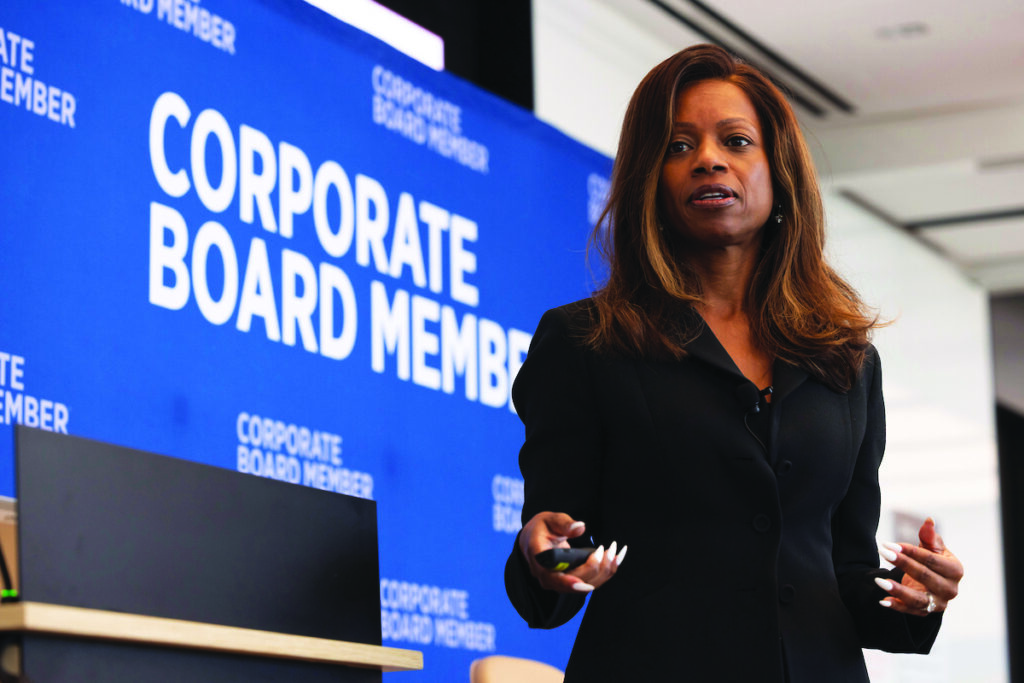
Dominique Shelton Leipzig, CEO of Global Data Innovation, outlined a comprehensive framework for building trustworthy AI that enables rapid innovation while maintaining enterprise risk controls.
The Trust Framework
Triage (T): Strategic alignment of AI use cases with business objectives and legal obligations. This involves understanding jurisdictional requirements—such as the EU’s 17 areas of prohibited AI—and ensuring initiatives support core business strategy rather than peripheral projects that struggle to demonstrate ROI.
Right Data (R): Ensuring data accuracy, proper governance and legal rights for training applications. “Do you have IP rights, privacy rights and business rights to train with that data? And do you have an audit log in case somebody challenges those things?” Leipzig emphasized.
Uninterrupted Testing (U): Continuous monitoring and auditing because AI models can drift at any time. “It doesn’t say that AI might hallucinate… It can be incorrect every second of every minute of every day. So, if your brand is on the line, you want to know that, so that you can go in and correct.”
Supervision (S): Human oversight systems that can respond quickly when AI performs outside acceptable parameters.
Technical Documentation (T): Comprehensive logging and metadata that enable technical teams to diagnose and correct model drift when it occurs.
“We’re at a fork in the road. We must use these technologies in order to realize the promise of AI is going to be close to $30 trillion to our global economy soon,” said Leipzig. “But we have to do it in a way that allows for the ROI and the realization of long-term value to actually occur.”
Building AI Foundations
Moving beyond AI pilots requires establishing the structural and cultural foundations that enable enterprise-wide transformation.
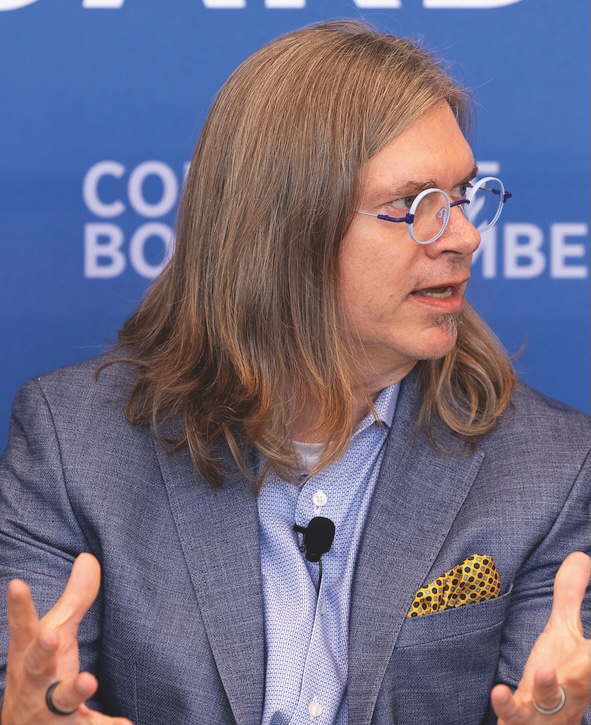
Strategy. Ben Schreiner, head of AI and Modern Data Strategy, Amazon Web Services, warned that current competitive advantages may not survive the AI transformation. “How your company got to this point—look in the mirror as a board or as a leader and decide: Is that competitive advantage potentially at risk with AI?”
Start with your customers, he said. “Your customers will leave you the minute they find something better than the offer that you give right now. That is your competitive advantage— keeping or retaining those customers by providing them a level of service.”

JoAnn Stonier
Data. Many organizations struggle with what “AI-ready data” actually means. In plain language, “data needs to be curated, data needs to be understood, data value needs to be understood,” said JoAnn Stonier, executive advisor at Cantellus Group. The key is focusing on specific business problems rather than trying to organize all data at once.
Most organizations suffer from “data debt”—years of neglecting proper data management. “There are organizations that can help you, but it takes time. And only your organization knows what is of value for the problems you are trying to solve.”
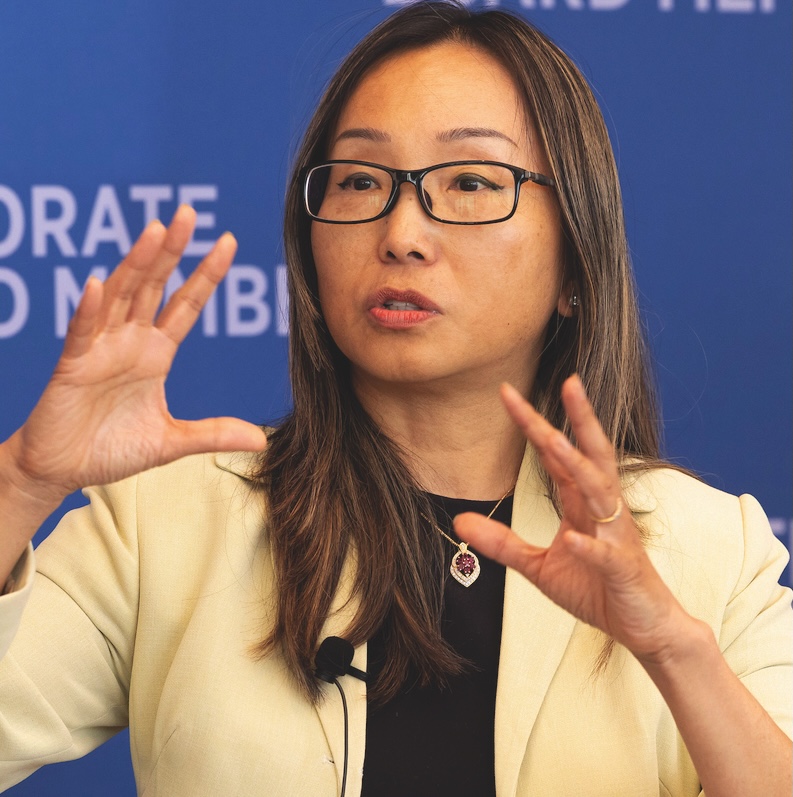
Culture. Angie Ruan, CTO for capital access platforms at Nasdaq, says her organization enables AI adoption across all employees rather than limiting it to technical teams. “This is not just about technology folks like me. This is actually every single person in the company.” Nasdaq’s approach is constant practice: “Every day, maybe every hour, AI is part of that conversation. It’s part of the things we do and you practice, you learn, you fail, experiment.”
The key? Governance frameworks that enable safe experimentation. “It’s about how to do AI safely. How to empower the innovation in a safe way.”