
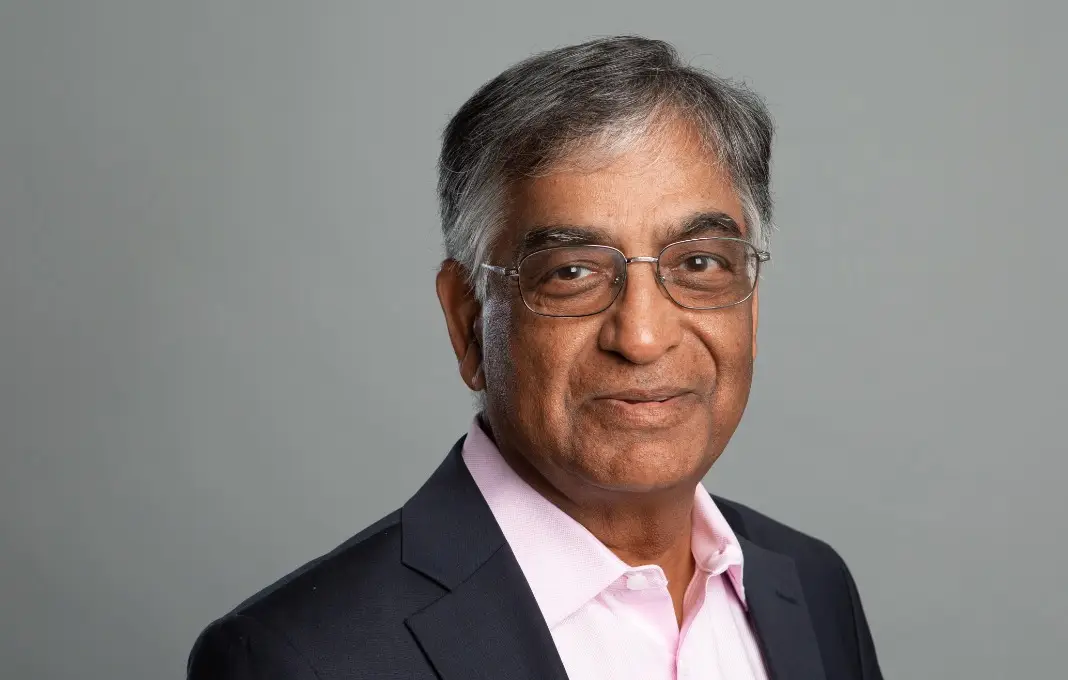
Raj Gupta, veteran of 15 public company boards, including Hewlett-Packard, DuPont, Tyco, Arconic, Airgas and Delphi/Aptiv, will be the closing keynote speaker at our annual Director’s Forum retreat in Scottsdale, AZ, March 3-4, 2026. Join us: boardmember.com/directorsforum
Raj Gupta has seen enough boardrooms to know when something fundamental has shifted.
Over four decades, he built a career at specialty materials company Rohm and Haas, rising to chairman and CEO before navigating its sale to Dow Chemical during the 2008 financial crisis. He’s served on 15 public company boards— Hewlett-Packard, DuPont, Tyco, Arconic, Airgas, Avantor—holding long-term chair positions at Delphi/Aptiv for seven years and Avantor for 12. He’s watched roughly 35 CEOs in action across industries and economic cycles, from the dot-com bust through the pandemic.
It’s been a long journey from the small village in Uttar Pradesh, India, where Gupta was born, arriving in the United States in 1968 at age 22 with $8 in his pocket to pursue graduate studies at Cornell. That perspective—of someone who navigated multiple worlds and built success from scratch—informs his current conviction that boards need to fundamentally reimagine their role around value creation.
His thesis: The VUCA world—volatile, uncertain, complex and ambiguous—offered relative predictability compared to where we are post-Covid. Boards could rely primarily on management’s inside-out view because major business trends remained consistent even through cyclical ups and downs. But that world has given way to what Gupta calls the BANI environment—brittle, anxious, nonlinear and incomprehensible—where technological disruption, demographic shifts and geopolitical volatility are accelerating simultaneously. “The world outside is changing so fast and so dramatically that CEOs need to think of the board as an active partner,” he says. “Taking the inside-out view is not going to work.”
To win in a BANI world, Gupta believes directors must shift 60-70 percent of their time away from oversight and compliance toward strategy, talent and risk—not by meeting more often, but by fundamentally changing how they spend the five or six days a year they’re together. That means delegating oversight to committees, demanding outside-in perspectives through expert briefings at every meeting and engaging in substantive debate about options rather than nodding at management presentations. “The best answers come out when you’re looking at options,” he argues.
It’s a vision that will make some CEOs and directors uncomfortable. Gupta is calling for boards to be far more active partners in shaping strategy, not just reviewing it annually. He’s arguing for creative abrasion in the boardroom. And he’s insisting that in a world of compressed timeframes and multiplying risks, companies need focused portfolios and deliberative decision-making on consequential choices—even when that seems counterintuitive.
What follows is Gupta’s roadmap for how boards survive and thrive when the old rules no longer apply, edited for length and clarity.
You spent four decades in boardrooms—Rohm and Haas, Tyco, HP, Delphi, Avantor, 15 public companies—you navigated the dot-com bust, the financial crisis, activist campaigns, massive transformations. Why are you talking and writing about boards needing to focus on value creation so much right now? Isn’t that always the job?
The reason I’m reflecting on this is the difference between, let’s say, the VUCA world and the BANI world. In the VUCA world, obviously, there was uncertainty, there was cyclicality, there were ups and downs. But by and large, the major trends in businesses were very consistent. If you look at buying power and demographics, 70 percent, 80 percent of the demand was Western Europe, United States, Japan. The rest of the world was kind of an also-ran.
Now the purchasing power in the developed world—where the population is declining—is declining. In emerging markets, including Africa, South Asia and India, the population is rising. The living standards are going up, the spending power is there, and education and the talent pool are there. A lot of companies in China, India and around the world are becoming powerhouses. Combine that with geopolitics, and deglobalization versus globalization is becoming a play.
When I talk about the BANI world, it is about the uncertainty and the number of factors causing uncertainty and the speed at which they’re changing. We are talking about major technological changes, major demographic changes, major geopolitical changes and the speed at which they’re changing is much more rapid.
If you are operating in a world where the environment was relatively stable, there were cyclicalities, ups and downs, and through all those, you effectively relied on the board to provide oversight and guidance and help with major decisions. But by and large, boards relied on the management. It was an inside-out view ruling, and that’s especially true if the company was successful. They saw the world from their perspective, they had a long history, their certain way of working, and it was successful. Now, what I am am saying is the world outside is changing so fast and so dramatically that CEOs need to think of the board as an active partner. Taking the inside-out view is not going to work.
You say boards really need to expand their charter beyond compliance and risk management to actively shape strategy and growth. But directors would push back and say, “We already do strategy.” So what’s wrong—in your mind—with how we’re doing strategy right now at the board level? What do you think needs to change?
Typically, once a year, each of the division heads, the CFO and the CEO take half a day and lay out for the board, “This is our strategy, this is our plan, these are things we are looking at.” Generally this tends to be an extension of what the company has been doing, with maybe some marginal changes. And the reliance on those plans is usually mostly inside data and their understanding of the marketplace, with some input from the outside about how the landscape is changing. Then those things just get filed away until the next review a year later.
Most of these are just presentations. They reflect the management perspective. Historically, this may have been correct because boards were not very well-informed about what is going on in the landscape of the company. But now, if boards are responsible for long-term value creation, they have to shift their allocation of time away from oversight, compliance and quarterly results to spend the bulk of their time talking about talent, strategy and risk in the new world. In order for them to do that, one of the things they clearly need is more outside-in view and more education.
You can imagine a lot of CEOs and CFOs reading this article and saying, “I love my board, but they’re not here to operate the company.” Help us strike that right balance of cadence, engagement so that the board can be an advisor but not really try to be an operator.
For sure. And I’m not talking about increasing the time commitment. Five meetings a year, a day or day and a half, is more than plenty. But where they spend the time during those meetings and what the agenda is focused on is really what I’m talking about. Instead of spending 60 percent of their time on oversight, compliance and short-term results, refocusing 60 percent to 70 percent of the whole board’s time on talent, strategy and risk. Basically transferring the responsibility for oversight and compliance to the committees. The audit and finance committee, the human resources committee and compensation committee, and the governance committee—let them do the work of compliance and oversight and obviously inform the board as to what the issues are, what changes they’re making and what questions they have raised.
Typically, because boards are not as up to date or not as involved with the details, even the time they spend on strategy is mostly presentations. These are presentations from the division heads or the head of strategy, the CFO or the CEO. It is not a discussion about the business, the changing landscape, the threats and the opportunities, and looking at options. One of the big things that I have come to conclude based on my experience is the best answers come out when you’re looking at options.
Send the material in advance to the board, expect them to be thoroughly reading it, and when they come to the boardroom, they are basically engaged in the conversation and challenging each other and challenging the management or coming up with other ideas. And in order for them to do that, it comes back to how do boards get educated and get outside-in perspective?
One thing that I have seen work well with boards I’ve been on is when, at every board meeting we had, either an industry expert, consultant, investment bank analyst, customer or somebody comes and presents their view of the space that the company is in and the company. So you are really getting an outside view from different perspectives. On the customer perspective, how do they compare you with the competition? You have your investment bank or a legal firm come in and talk about the risk of an activist approaching. Why do you have the threat, and what can you do about it? We had the ex-ambassador to Mexico come in when all this geopolitics was happening with Mexico and China to talk about how the board should be navigating the journey.
So, in addition to bringing their own experience, they are also learning more about what is relevant—outside things that are happening that will affect this company.
How does the board organize itself to engage with risk more strategically?
Traditionally, once a year, every company has their general counsel or risk manager come in and say probability and impact, usually the graph they show you. And most of it focuses on operational risks. What happens if this plant shuts down or this customer walks away? That kind of thing. The second aspect of this is a little higher-level risk, the business risk. That means how competition could change, how technology could change, how customers’ supply chain could change, if a strike could happen in the plant, much more about business risk at a higher level.
The third one, which rarely gets talked about, and I think Covid brought this up in the last few years, is unexpected external risks. When you think about those, they are multiplying and having a bigger and bigger impact than they used to. Some of them are man-made. If you go back to the regulatory environment in the past, it was Europe and the EU that controlled most of corporate regulations. Now you have China, you have Brazil, you have everybody. Geopolitics and politics becomes such an important element of human-made risk. Then there’s nature: fires, earthquakes, floods, hurricanes, pandemics. I don’t know how much of this you can incorporate, but you have to at least think about things like regulatory actions and geopolitics or even some natural events in terms of flexibility of supply chain that you don’t want your supply chain to be 100 percent tied to one geography or one country or one supplier, which is where the world moved when China became the lowest cost producer for so many things.
It’s those outlying 5 percent risks that we don’t discuss because they’re 5 percent risks.
Most companies have this risk probability and impact but just thinking about some of them in a very different way based on our experience over the last few years. Because in addition to the pandemic I think you will be surprised how many earthquakes and fires have disrupted supply chains.
There’s a fair amount of theater that goes on in boardrooms where everybody dutifully nods at PowerPoints. How do you create a culture where there’s dissent, where there’s constructive argument without creating paralysis or dysfunction? You call it creative abrasion.
The starting point of this is the CEO’s willingness to not feel that he or she has to have all the answers and all the board is there for is to nod yes or no, hopefully most of the time nodding yes.
The choice of the board leader also becomes critical because the board leader requires two things: First, complete total trust and transparency with the CEO. The CEO feels comfortable that the board is not just the boss that will fire him or her or pass a judgment on him or her, but that the board is really a partner. Second, the board leader has support and confidence with their board colleagues.
Frankly, it doesn’t matter whether you have an independent chair or a chairman CEO and a lead independent director. As long as you have clear definition as to the role of the independent chair or lead independent director versus CEO. That goes back to not trying to get too much into nuts and bolts, but staying more on the strategic level.
How do you select the board leader? I admired Jack Krol, who unfortunately passed away, he was ex-CEO of DuPont, and he was chair at Delphi, and was lead director at Tyco before that. For two years in a row, as part of the annual board assessment, he asked each of the board members, “I’m planning to retire, and if it’s not you, who would you suggest would be the next best board leader?” He asked for two years in a row, until it became clear that 90 percent of the board said I would make the right leader. And then, of course, he engaged with the CEO to make sure he would be comfortable because he was stepping in at the same time I was stepping in as chair. This goes back to the trust between CEO and the board leader, and the board leader having the respect of the board.
And then you come back to say, how do you create a climate or environment where CEOs don’t feel like they are there to present the strategy, present a recommendation and ask for a yay or nay as opposed to really having a conversation, and debate and discussion? One of the things I learned the hard way based on my HP experience is anytime you have a consequential decision to make, whether it’s succession, talent or about a major investment, don’t rush into the decision. The price you pay for making a wrong decision is just huge.
Make sure you take the time when you’re making the important decision. What do you do with that time? You look at options, you ask the questions, you ask what is the risk is if it doesn’t work, or why are we paying so much for this asset? What are we going to do with this? How are we going to integrate this? Is there something else we should be thinking about? That goes back to how do you create an environment in a boardroom where this constructive conversation and even a conflict is something that is accepted? If the CEO and the management team are talking about options, the pros and cons, it opens the gate for others to express their opinion.
When you’re the board leader, it’s very important to keep bringing management back to, “Let’s talk about options.”
Absolutely. And what are the risks and opportunities, and the risk of those versus opportunity that come out of that?
The thought exercise itself is useful for the entire board, for culture creation and to sharpen management’s own thinking.
Exactly. To give you a great example, when Delphi decided about five, six years ago to get out of the gasoline and diesel engine and focus on hybrids and EVs because they were a higher growth, higher margin business and a new class of customers, we had a number of board members who came from the traditional automotive industry, and they were very much against the idea of splitting the company. Instead of just pushing our way or the management way, we took three or four board meetings to have a discussion about this topic. “What are the pros and cons? What are the risks? What’s the value? Why are we doing this? What is the minimum value that we would accept to divest that asset? Should we be considering an IPO, a spinoff or a sale?”
We took six months, and it was very important to spend the time to get the consensus of the board and understand the risks and opportunities and how to get them to go about doing this.
Let me push back on that: In the VUCA world and now in the BANI world, we have been told, and we all feel it, that we live in an era of compressed timeframes, a world of pandemics, wars, trade craziness. How do you square this more deliberative approach to board work while we’re also living in a world that seems to be oscillating faster and faster and with more amplitude?
This is another very important part of the conversation. The more complex your portfolio, the more diverse it is, the harder it is for management, let alone the board, to stay engaged. What Larry Culp did at GE is fantastic. He not only saved the company, the company is thriving. Many other companies are following the same model. Ed Breen did the same thing at Tyco.
The only way a company can survive and thrive in a BANI world is to have a focused portfolio and a long-term commitment to build a position, and then also to have the courage to say, “We will navigate all the ups and downs and external changes.”
Focusing the portfolio, staying abreast of what’s going on in the world, having the right skills on the board, having an ongoing conversation and, of course, deferring to the management in terms of dealing with the short-term issues.
Traditionally, of course, why people bulked up and why GE became GE and why Honeywell was Honeywell, why Tyco was Tyco, was the idea that there is less risk in being diversified. Having counter-cyclicality to ride out storms. Now you’re saying that the risk really is in the complexity. You really think you need to strip down and do what traditionally has been the opposite of what people do to de-risk their companies?
Very much so. It’s basically saying you must have a compelling reason why you are in two very different businesses under one umbrella. In the BANI world, focused portfolios, leadership positions, the ability to invest and to attract talent and keep your story very focused, I think it’s a powerful thing.
Also, the board can go deep. That 60 percent of the conversation you’re now having at each of the board meetings is much more substantial because you’re not getting tied up in reviewing all the different divisions of the company. You really can get closer to management and have substantial conversations.
At Tyco, ADT was there and flow control systems were there. I mean, they had so many different businesses, and they had no connection with each other, so the boards knew very little. Even management does not have enough knowledge about each business to really be thinking long term and be able to deal with challenges in each one of them.
One thing we haven’t talked about yet is technology and how you think that should shape who’s on the board and what the board talks about. What’s your sense of how AI and new technology is going to be influencing the role of the CEO and board going forward?
This probably happens not too frequently, maybe every decade, every two decades, when a new technology comes out that has ramifications across industries and across the globe. This particular one definitely falls in that category—even more than the internet. The internet just made communications easier and data exchanges easier. But it wasn’t leading or prompting better decisions. What AI has the capability of doing is to really think like a human brain, and in a repetitive process, even faster and more accurately than human beings can. That’s really what it is.
AI is able to not only look at the company data but outside data that’s relevant. They have global information. You have repetitive tasks that you’re doing in the company, whether it’s your supply chain, production, financial analysis, all of those things, which require a lot of data coming from different places and a lot of people involved, a lot of cost is involved, a lot of time is involved. Identifying opportunities where you can dramatically take cost out and make your systems and cost structure more efficient is the first thing that one should target in terms of AI.
The second is, how do you improve your customer experience? You can improve your processes, reduce the cost and accuracy and promptness, improve your customer experience. And the third one is, if you are able to do that, how do you completely change the end markets so that you can serve more efficiently than your peers, either entering new markets or displacing your competition?
Companies and boards should be thinking about things in those terms, what is it that we can do to become more efficient? What can we do to improve our customer experience? And what can we do if we are successful to change the game?
Is it worth carving out time specifically for AI? Or is this just part of the discussion about running the business?
I would rather have boards spend 60 percent, 70 percent of their time on strategy and long-term value creation—and AI should be part of it. It should be part of the education and also asking management, “How are you doing this?” Because companies don’t know how many initiatives they can fund and support while this is evolving.
Then asking the CEOs, the CFOs and the operating guys: “How are you really executing this? How are you prioritizing and killing some of the stuff and focusing on something that really has a value opportunity?” It doesn’t necessarily mean skills on the board or AI because I’m not sure there is one single person or even a few people who can bring all the expertise to the board about AI because it is still evolving. But staying current, knowing what’s going on, asking the company, “How are you leveraging it?” Because every company has AI on their mind to become more efficient and grow faster.
We started with—and it’s not a terrible place to end—how job one of the board is to get the right CEO. What does the right CEO look like in the BANI world? What should we be looking for in the person to lead the company?
A generalist mindset. I don’t think domain expertise is all that necessary unless you’re in a very focused area. Track record is a given, right? I mean, that you have been successful. But a generalist mindset and a willingness and ability to listen and learn, is very, very important, rather than being directive based on your experience and telling your organization, “Do this, do that. That’s what we should do,” as opposed to listening.
Another thing, I would say, is humility. It’s such an important trait in today’s world because it doesn’t matter how good a decision you make, you are taking risks and you are likely to be wrong. Building trust and transparency with your stakeholders, which includes the boards, your executive team, your customers and your investors, all of that requires a level of humility and a trusting relationship, which really means communicating very honestly, and forthrightly, and frequently. Admitting mistakes and pivoting‚ learning from mistakes and pivoting.
A final thing I would say is the ability to connect the dots. This goes back to more intuition, experience and wisdom than it goes to specific knowledge. That is such an important skill. There are so many moving parts. And then somebody comes in with a new idea. You don’t have to have all the logical answers, but you have to have the ability, the intention and the courage to say, “That’s where we are going to put our focus.”