
Public company directors are feeling better about business conditions today than they have at any point since the end of 2024. But they aren’t counting on that momentum to carry into the year ahead.
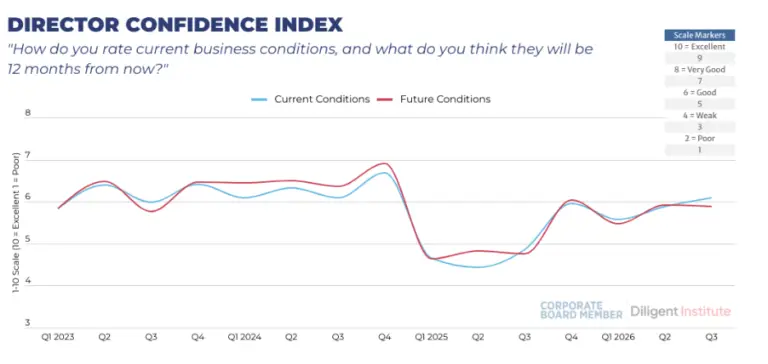
Corporate Board Member’s third-quarter Director Confidence Index, conducted in collaboration with Diligent Institute, finds directors rating current business conditions at 6.1 out of 10, up from 5.9 in Q2 and the highest reading since December 2024, when confidence stood at 6.7.
It marks another step in a recovery that began after the Index fell to 4.4 in the second quarter of 2025, amid tariff uncertainty and concerns about the direction of economic policy.
The outlook from here, however, is considerably more restrained.
Directors polled expect business conditions to fare at 5.9 out of 10 one year from now—essentially unchanged from their Q2 forecast but about 4 percent below their assessment of conditions today.
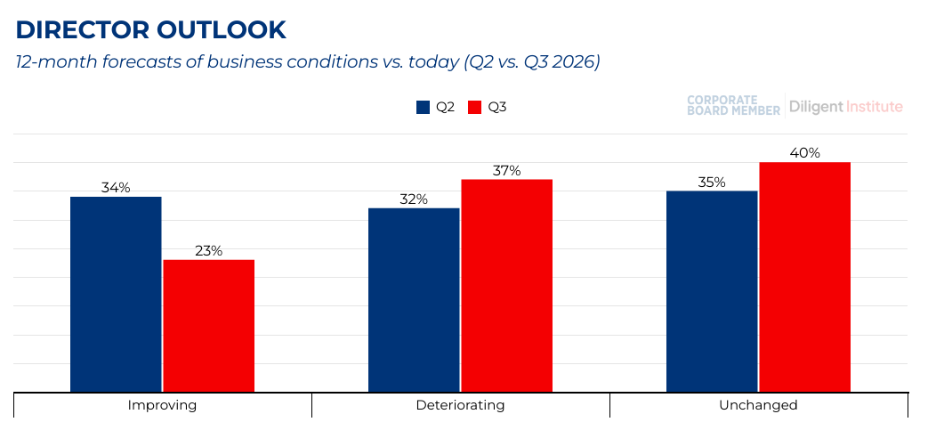
The share of directors forecasting improvement over the next 12 months declined 11 points in Q3, from 34 percent to 23 percent.
But not everyone turned negative. While the proportion expecting conditions to deteriorate increased from 32 percent to 37 percent, the plurality (40 percent) expects little change.
Asked what’s driving their outlook, cost pressures and geopolitical instability dominated the concerns of directors expecting conditions to weaken.
Among those whose ratings decline over the next 12 months, 40 percent cite inflation or other cost pressures, and 40 percent point to geopolitics, war or global unrest. Policy and government uncertainty, including tariffs and regulation, is cited by 20 percent, as are interest rates and the cost of capital.
“High interest rates and inflation [are] affecting business investment and consumers,” explained one director, echoing several others.
Directors’ comments reflect a concern that has run through the Index for much of the past two years: directors may be adjusting to volatility, but they still see an unusually large number of variables outside their companies’ control.
“The economy’s weakness is self-inflicted, not driven by external factors,” commented one director. “It’s hard to know what the current administration will do to strengthen demand and lower inflation, which are harming consumer confidence.”
Some directors expecting improvement or little change in the year ahead also cited geopolitics, rates, policy and inflation—but they anticipate those pressures will have stabilized or become more manageable by this time next year.
A Split View Across Companies
The outlook also varies by company size and sector.
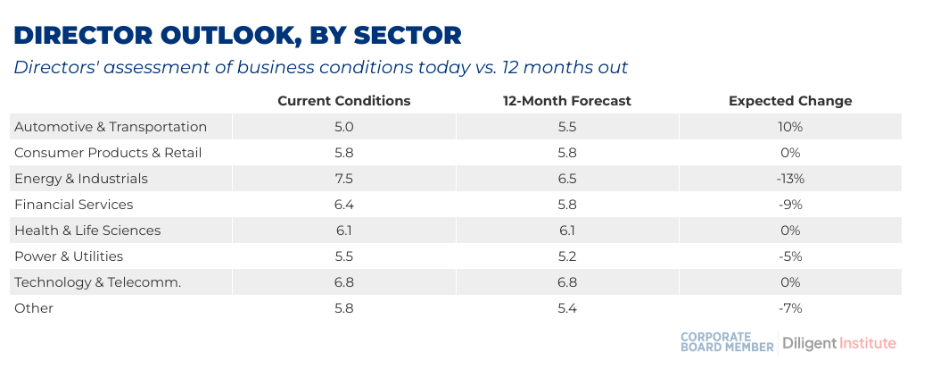
Technology directors are the most bullish, rating both current and future conditions at 6.8. Health and life sciences directors are similarly steady, at 6.1 today and 6.1 a year from now.
Financial services directors are more cautious. They rate current conditions at a relatively strong 6.4 but expect that to fall to 5.8 over the next 12 months.
The sector split reflects some of the forces shaping the broader market. Directors who are more optimistic frequently point to AI advancement and its potential to drive growth and productivity. Financial services, meanwhile, remain more exposed to the effects of interest rates and persistent inflation.
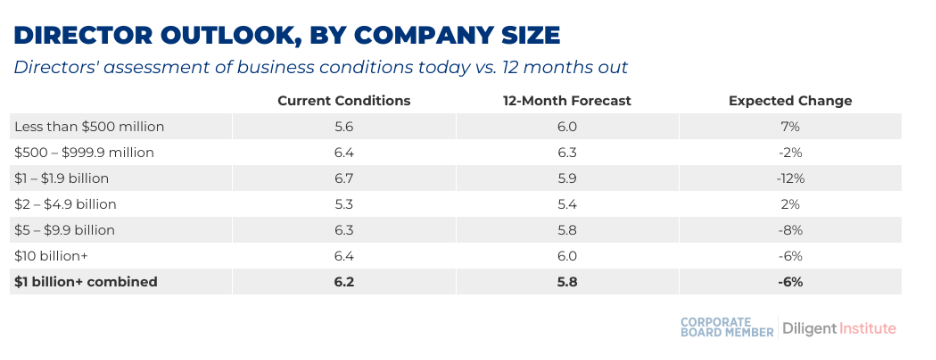
A similar divide appears looking at company size. Directors serving the largest companies ($1 billion+ in annual revenue) rate current conditions at 6.2 but expect them to slip to 5.8 over the next 12 months.
At the smallest companies (those with less than $500 million in annual revenue), the trajectory moves in the opposite direction, from 5.6 currently to 6.0 in the year ahead.
The difference may reflect exposure to global volatility. More than four in 10 directors at large companies cite geopolitics or related global risks in explaining their outlook, as they are generally more exposed to international markets, geopolitical disruption, trade and currency swings.
In contrast, smaller companies tend to be more domestically focused. Only 27 percent of directors at companies below $500 million cited geopolitical reasons for their outlook, instead more often focusing on demand and the U.S. economy.