
Jason Warner has a pretty good idea what a business strategy looks like right before it goes wrong. Long before he began building frontier AI models, he was an IBM intern in the 1990s, watching the company that had once owned the entire technology industry slip into a slow slide of incremental bets, conservative product development and failure to hold strategic turf that would eventually leave it maintaining mainframes and Cobol while the rest of the world—a world increasingly centered around Silicon Valley—moved on.
He’s seen something similar repeated again and again throughout his Zelig-like career in tech, a career that includes four years running engineering at GitHub, two before Microsoft acquired the company and two after, building GitHub Actions, Packages and the analytics tools most developers touch every day. He’s also the person behind GitHub Copilot—he tried to acquire a startup to become its technical foundation and met his future co-founder in the process.
Then came the disagreement that ended his time at Microsoft. After the acquisition, he says the company wanted the next generation of Copilot built in lockstep with OpenAI. Warner says he argued that handed away the one thing GitHub actually owned: the strategic ground underneath its own product. Microsoft moved ahead anyway. “They weren’t recognizing that they were a cancer patient on chemo—a stage four cancer patient, if you will, and just delaying the inevitable,” he said of that decision. He left rather than watch it play out.
Today, Warner is CEO of Poolside, which he co-founded to build frontier foundation models designed to run inside a company’s own walls—even air-gapped, with no outside connection. Poolside is building a 10-gigawatt data center campus in West Texas that would be the largest energizable site in North America, while the company just released a new open-weight model Warner said rivals China’s Qwen.
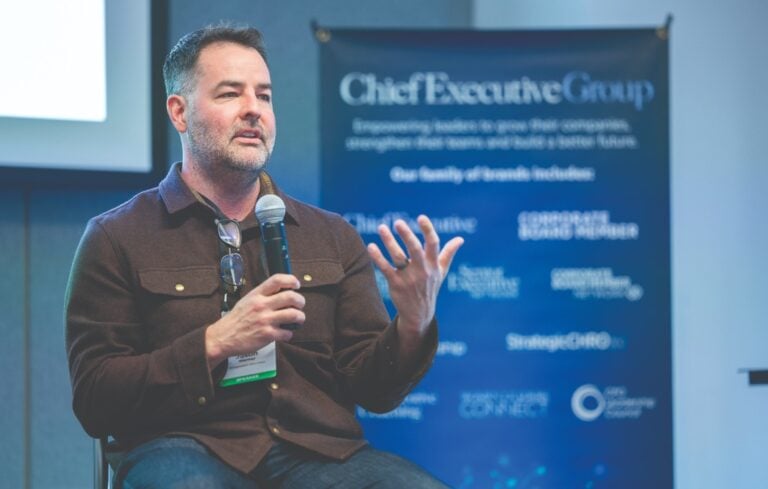
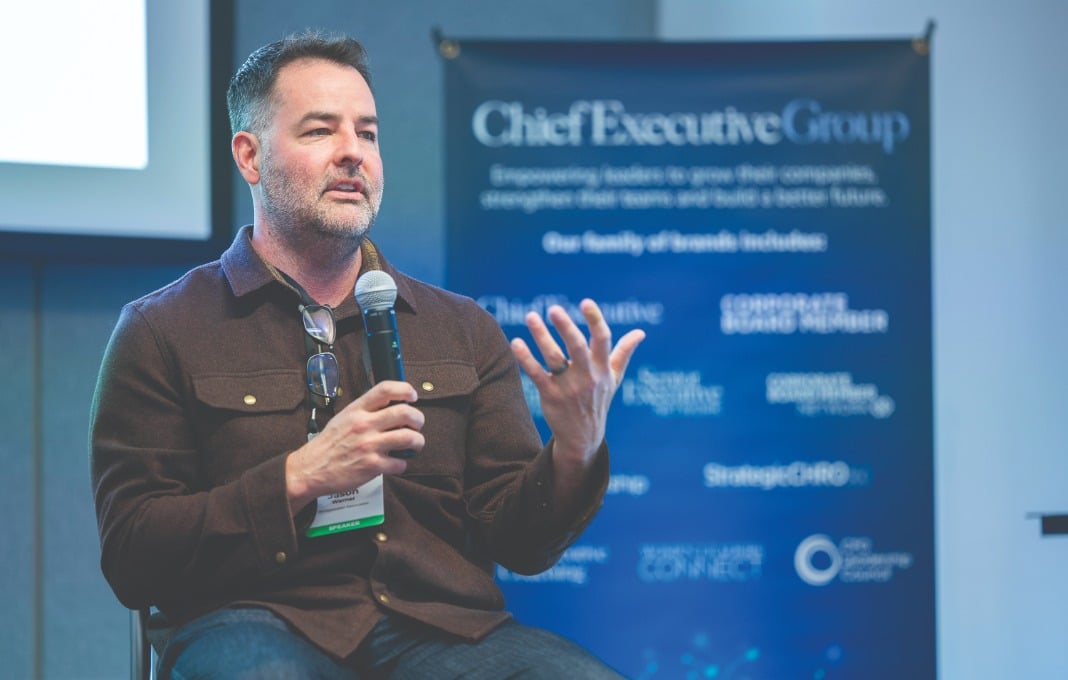
In April, at Corporate Board Member’s AI West event in San Francisco, running raw on no sleep from the model launch, Warner sat down for an interview in front of a room full of working directors, removing what he calls his “vendor hat” and laying out, bluntly, the trap he thinks hundreds of public companies are about to walk into. “All of the frontier labs are trying to offer you the devil’s trade,” Warner told the room.
His argument centers on the history of disintermediation that predominates two recent technology cycles. Nortel, Cisco and Broadcom may have built the physical internet in the 1990s, but they captured almost none of the value it created—Amazon and Google did. Amazon, Google and Microsoft then did it again, building the hyperscale clouds on top of which Uber, Airbnb and GitHub were built. Foundation models, in Warner’s view, are just the latest iteration of this same story. They are the next layer of critical infrastructure to be built, and nearly all the value AI creates will accrue there—not to whatever gets built on top of it.
He said he made this case directly to JPMorganChase CEO Jamie Dimon, who saw the issue immediately and put the strategic remedy bluntly: “If what you’re telling me is fundamentally that for the first time in human history,” he quoted Dimon saying, “we’re divorcing economic value creation from human labor, then why would I ever rent that? Why wouldn’t I own that?”
It’s a good question, and in Warner’s view, the most essential question now confronting boardrooms and C-Suites around the world. Unfortunately, he said, in the token-maxxing, FOMO gold rush to show AI proficiency, far too few executives and directors are asking it—especially when weighing the enormous capital costs of building their own AI systems versus the pay-and-play opportunities offered by companies like Google, Anthropic and OpenAI. That, he said, is an enormous strategic mistake.
While Warner is the first to admit he is talking his own book here as the CEO of a rival AI company, that doesn’t make him wrong. Here are key tips for directors from his session:
Don’t build your company’s future on infrastructure you don’t own. Generalized intelligence is a commodity, Warner said, treat it like oil. A handful of labs will produce it at a quality that’s effectively interchangeable, the same way a barrel from Texas and one from Saudi Arabia are interchangeable. Renting this kind of intelligence from a frontier model is fine—smart, even, the same way any company rents compute from AWS.
However, he cautions against treating any single frontier lab’s model as permanent infrastructure within your operations—that’s essentially building on land you don’t own, real estate that can be repriced, restricted or simply out-competed by the landlord itself. “Trying to build your forever home on two-year leaseback land, you’re in trouble because you don’t own what’s underneath you,” Warner said. At the very least, diversify your sources so you don’t become strategically dependent on any single vendor. That’s a vulnerability you can avoid.
Cultivating judgement in your people will become existentially important for companies. The most important skill that survives automation isn’t technical; it’s the ability to sense when something’s off. In software, for example, memorizing a spec or code syntax is already worthless. What’s left is the instinct that catches a problem before the data confirms it. “We all know the engineer that you want in the room during an outage,” he said, “because once they’re in the room, they’re saying, ‘Hey, something feels off. I bet it’s over in this weird system over here.’” That instinct doesn’t come from a model—it comes from people who’ve spent real time inside a business. Warner thinks boards should be asking whether their organizations are still building that judgment—or quietly outsourcing it away.
“That type of skill is not going away because that type of skill universally translates to every business domain, every domain that we’re in. It’s intuition,” he said. “But you only build that intuition by working in that industry and working around the experts.”
Your real advantage isn’t your data—it’s the patterns only you can see. AI has moved past learning from the content of a company’s data—the case files, the customer records—to learning from its context, Warner said. What matters isn’t the content sitting in a company’s systems; it’s the pattern of how those systems work together. He points to Reuters as an organization getting this right. Building on its Westlaw brand, they aren’t focused on easy-to-commoditize LLMs of case law. Instead they use their unique expertise and proximity to customers to map how law firms operate—the roles, the workflows—to create products that enable a defensible competitive moat that can’t be replicated easily. “It’s not the content,” he said. “It’s the context of all the disparate systems as they play together.”
“I’m not going to name names, but any frontier lab walks into an organization and says, ‘I love what you do. We would really like to partner with you and give you free access to the model or subsidized access to the model. But to do that, what we would like is to sit down with you and really map out your business. Really understand what it looks like so that we can better serve you.’ They fundamentally are taking what is proprietary to you to some degree and they’re baking it into that next generation of model. And it’s slow at first. It doesn’t look like it’s doing anything, but all of a sudden you can see the benefit in your business, yes. But now they can go to your competitor or somebody else in the industry, and now they become the industry vertical.”
Most important: Ask what your company is really world-class at, before a model learns to do it too. Warner’s strategy test for directors comes down to one question: What does our company do that’s genuinely defensible, and could an outside model quietly learn to do it instead? That’s the thing you need to build in-house, says Warner. Even if it is expensive.
“The hard part for anyone sitting in this room is that this feels like what I’m saying is go build an OpenAI or an Anthropic,” he said. “That’s not what I’m saying. What I’m saying is that you do have to understand how you can build some intelligence inside your organization. Some small group of people that understands your data and your workflows and is able to extract those out from your system and synthesize those into results. Yes, these people are hard to find right now because these are the most precious humans on the planet who can build small models and build things like this. But it’s the same thing as when mobile came around or the internet came around. You just have to adapt. You have to start building it. Don’t throw up your hands and just say, ‘That’s not our business.’”