
A CEO running a publicly traded company and one leading a private equity-backed business may face remarkably similar pressures: grow revenue, improve margins, deploy capital effectively and create value for shareholders.
Their compensation packages, however, can look radically different.
In 2025, median CEO compensation among S&P 500 companies reached $17.3 million, according to the AFL-CIO’s 2026 Executive Paywatch report, based on publicly available SEC filings.
According to Chief Executive Group Research’s latest survey of 1,551 U.S. companies, that compares with $583,367 for CEOs of private equity-backed companies.
The gap is enormous. But there’s more to the story than the size of the paycheck.
First, public-company CEO compensation is heavily weighted toward equity, with stock awards and other performance-based incentives accounting for much of the value reported.
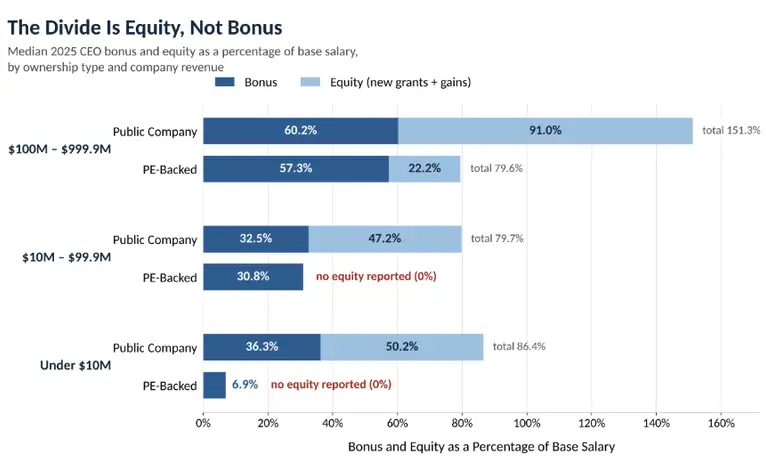
Our data shows public-company CEOs received a median $331,000 in new equity awards in 2025, compared with $0 reported for their PE-backed counterparts. Public-company CEOs also received a median annual bonus equivalent to 62 percent of their base salary in 2025, compared with 38 percent at PE-backed companies.
That doesn’t mean PE-backed CEOs lack equity incentives. What our research has demonstrated is that unlike publicly traded stock, private-company equity isn’t consistently revalued or reported annually, and its ultimate worth is often not realized until a sale or other liquidity event.
A Tale of Two Frameworks
Public-company compensation committees typically establish performance measures, vesting conditions and payout opportunities designed to reward results over several years. Those measures can include earnings, return on invested capital, relative total shareholder return and other financial or strategic objectives.
PE-backed companies operate within a different ownership framework. The investor group is generally more concentrated, and management incentives may be linked to a clearly defined value-creation plan and an eventual liquidity event.
The practical distinction: A public-company CEO may receive equity awards each year, while a PE-backed executive’s largest potential reward may be tied to what the company is worth when the investment is realized.
Neither arrangement is inherently better. They create different incentives and expose executives to different risks.
The Lesson for Boards
For public-company directors, PE compensation practices offer a useful question about focus. Are incentive programs sufficiently connected to the handful of outcomes that create the greatest long-term value? Or have they become complicated structures in which executives struggle to understand the relationship between performance and reward?
For PE-backed boards, public-company practices offer a different question. Are incentive programs transparent, are potential rewards clearly understood, and is oversight rigorous enough to balance management motivation with investor expectations?
Both groups must also consider what executives can actually control. A performance target influenced heavily by market conditions may produce substantial rewards—or disappointing payouts—without accurately reflecting management’s contribution.
Likewise, equity participation can align interests over time but also expose executives to valuation changes they cannot fully influence.
The compensation debate—whether public to PE, public to private or among private structures themselves—often focuses on the disparity in total pay. That disparity is real and considerable. But for boards responsible for attracting, retaining and motivating senior leadership, the more consequential issue is whether compensation creates the right incentives. A multimillion-dollar package can be poorly designed. A much smaller one can be remarkably effective. What matters is whether executives understand what they’re working toward and whether the rewards are worth pursuing.
For more benchmarks by company size, industry and ownership structure, explore Chief Executive Group Research’s latest CEO & Senior Executive Compensation Report.